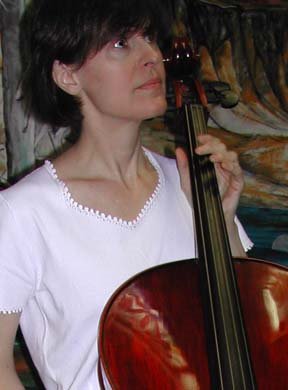
Thu 0:42 (1441-1523)
Warmed up with open strings G C G D A DG then slurps across D and G. Really sitting right down there on the bridge, experimenting with bow speed on the different strings. Explored the sequence bow level change then bow change motion when going to a higher string on up bow. 10 min
Then it was logical to start with the little string crossing section in the Vivaldi (Spring) 1st mvmt. Worked from double stops in correct pulse. Seemed to work "OK" with just a little elbow drop after the pulse. Would be worth discussing this bowing at a lesson.
Next, fingering for soli section in the 3d mvmt. Loving how my bow weight from open strings is still carrying over.
Ran through the Handel, which we will be performing at a little recital tonight. Just took it under tempo, polishing a few shifts, and staying loose.
15 min or so on Apres un Reve, playing it with exaggerated passion and phrasing, big vibrato while, yes, focusing on keeping the right arm relaxed and weighted. Fun.
Back for just a few more minutes of Handel, and that's all for today. Warmup for recital at 6, recital at 7.
Thursday, April 8

Tuesday, April 6
Tue 0:30 (1238-?)
First half hour
10 min Open G. At the end, was playing with bow speed - fast into change, slow out of it seemed to make the smoothest changes.
10 min Apres Un Reve. Shifts and bow weight.
10 min Handel, slightly under tempo, going for smooth sound.
Then I spent most of the rest of the afternoon with my orchestra music, listening to recordings while following the cello part, getting scared and depressed. Overtures are fun to listen to, but a bear to play, and a "light" program filled with overtures is a nightmare. There, I said it. Now that I've cleared the air, I can get down to work, but first I need to survive rehearsal tonight.
First half hour
10 min Open G. At the end, was playing with bow speed - fast into change, slow out of it seemed to make the smoothest changes.
10 min Apres Un Reve. Shifts and bow weight.
10 min Handel, slightly under tempo, going for smooth sound.
Then I spent most of the rest of the afternoon with my orchestra music, listening to recordings while following the cello part, getting scared and depressed. Overtures are fun to listen to, but a bear to play, and a "light" program filled with overtures is a nightmare. There, I said it. Now that I've cleared the air, I can get down to work, but first I need to survive rehearsal tonight.
Sunday, April 4
Sun 0:35 (1330-1405)
Weird, I think I practiced yesterday, but I can't remember it.
Today I was up at 0545 to play 2 services in church. Practiced ~35 minutes afterward. Warmed up with a few open strings, then E MAJ in a variety of patterns. Worked on Apres Un Reve for about 15 min, and spent the remainder of the time on Handel. OK, not so productive, but I was tired. Still am, evidenced by my loss of yesterday's practice memories.
Interesting morning in church. Turns out T4-'s in-laws attend my church, so T4- was there visiting. While they had hired an extra violin and 2 violas, I was the only cello, and evidently one of the cameramen liked my bright green shirt. It seemed like every time I looked up I had a view of my bow hand. (DH said I had more than bow hand cameos, but I spent most of my time looking at the music, not the screen.) Or, maybe my bow hand just looks especially graceful now, attracting even the attention of the non-musician cameraman? Hah!
Weird, I think I practiced yesterday, but I can't remember it.
Today I was up at 0545 to play 2 services in church. Practiced ~35 minutes afterward. Warmed up with a few open strings, then E MAJ in a variety of patterns. Worked on Apres Un Reve for about 15 min, and spent the remainder of the time on Handel. OK, not so productive, but I was tired. Still am, evidenced by my loss of yesterday's practice memories.
Interesting morning in church. Turns out T4-'s in-laws attend my church, so T4- was there visiting. While they had hired an extra violin and 2 violas, I was the only cello, and evidently one of the cameramen liked my bright green shirt. It seemed like every time I looked up I had a view of my bow hand. (DH said I had more than bow hand cameos, but I spent most of my time looking at the music, not the screen.) Or, maybe my bow hand just looks especially graceful now, attracting even the attention of the non-musician cameraman? Hah!
Friday, April 2
Fri 0:40 (~1600)
10 min Open G, single note C or D on III, a few 2 string slurps
20 min Apres Un Reve, about evenly divided between 1st and 2nd thirds. I'm really not sure which string to finger the last 3d on.
10 min Handel, mostly focusing on the shifts.
I may be deluding myself about sounding better, but the ringing tone I am getting out of the cello is definite incentive to keep playing.
10 min Open G, single note C or D on III, a few 2 string slurps
20 min Apres Un Reve, about evenly divided between 1st and 2nd thirds. I'm really not sure which string to finger the last 3d on.
10 min Handel, mostly focusing on the shifts.
I may be deluding myself about sounding better, but the ringing tone I am getting out of the cello is definite incentive to keep playing.
Thursday, April 1
Thu (~1200)
Yes, I have practiced this week, but not logged it.
Sun - 2 church svcs, decided to take a practice day off
Mon - ~25 min before lesson
Tue - ~30 min, 10 min of open G
Wed - ~40 min, 10 min of open G
Today ~ 30 min
10 min - open G. This is hard to do if focused on the time, so I have been setting the timer. Rotate focus between string contact, hand motion, arm motion. Each day it's different. When my head finally gets into it it is very relaxing, and has already been paying huge dividends, with more ringing sound.
10 min - Handel 1st mvmt
Changed the fingerings for the opening thumb position at lesson. Sounding choked rather than hymn-like was the impetus for my technical changes this week. Now there is much more shifting, and focus on linked legato. Really tells on me if I get tense!
10 min - Handel 2nd mvmt
Again, it's mostly about staying relaxed and balanced. Changed a shift - the ascending into TP scale. Instead of going from 1 in ext to thumb on MSH, I pup the thumb up on E as cart of the ext motion (E F# G#) and shift on the thumb to MSH. Pretty cool - we'll see if I can risk it in rehearsal!
Was planning to practice more after scheduled afternoon activities. Rehearsal went well, though. I scrapped most of my new fingerings - too unreliable under pressure with the performance next week - but the new bowing style worked well. Coach commented that I sounded louder. WoOt!
Yes, I have practiced this week, but not logged it.
Sun - 2 church svcs, decided to take a practice day off
Mon - ~25 min before lesson
Tue - ~30 min, 10 min of open G
Wed - ~40 min, 10 min of open G
Today ~ 30 min
10 min - open G. This is hard to do if focused on the time, so I have been setting the timer. Rotate focus between string contact, hand motion, arm motion. Each day it's different. When my head finally gets into it it is very relaxing, and has already been paying huge dividends, with more ringing sound.
10 min - Handel 1st mvmt
Changed the fingerings for the opening thumb position at lesson. Sounding choked rather than hymn-like was the impetus for my technical changes this week. Now there is much more shifting, and focus on linked legato. Really tells on me if I get tense!
10 min - Handel 2nd mvmt
Again, it's mostly about staying relaxed and balanced. Changed a shift - the ascending into TP scale. Instead of going from 1 in ext to thumb on MSH, I pup the thumb up on E as cart of the ext motion (E F# G#) and shift on the thumb to MSH. Pretty cool - we'll see if I can risk it in rehearsal!
Was planning to practice more after scheduled afternoon activities. Rehearsal went well, though. I scrapped most of my new fingerings - too unreliable under pressure with the performance next week - but the new bowing style worked well. Coach commented that I sounded louder. WoOt!
Saturday, March 27
Friday, March 26
Fri 0:40 (1710-1750)
A short practice today, partly because I am feeling very dispirited, and partly because I got myself into a time crunch and that's all I have had available so far today, and I'm not likely to have any more time later.
Started out with the Faure Apres un Reve, gooey shifts and memorizing the opening. The treble clef section is more problematic, both because of the position and because I am less confident that I am interpreting the fingerings correctly.
Did a short period of actual work on the Handel that we (cello quartet) plan to perform in a couple of weeks. Buffed up two small fingerings, but was otherwise discouraged that I am never going to have the volume and tone the coach wants.
Ah, well. Moving on, warmed down by pfutzing around with a Gabrielli ricercar one of our other quartet members is going to perform at the recital, than a bad run through of the top part of the Canon a Duo.
Some days, the bear eats you.
A short practice today, partly because I am feeling very dispirited, and partly because I got myself into a time crunch and that's all I have had available so far today, and I'm not likely to have any more time later.
Started out with the Faure Apres un Reve, gooey shifts and memorizing the opening. The treble clef section is more problematic, both because of the position and because I am less confident that I am interpreting the fingerings correctly.
Did a short period of actual work on the Handel that we (cello quartet) plan to perform in a couple of weeks. Buffed up two small fingerings, but was otherwise discouraged that I am never going to have the volume and tone the coach wants.
Ah, well. Moving on, warmed down by pfutzing around with a Gabrielli ricercar one of our other quartet members is going to perform at the recital, than a bad run through of the top part of the Canon a Duo.
Some days, the bear eats you.
Thursday, March 25
Thu 2:07 (1103-1310)
Warmed up on the Boismortier a minor 2nd movement, focusing on the Shifting Thing and playing all the shifts and scale patterns at slow, no tempo. Then played through twice at qu =60, stopping the first time to work over trouble spots, Finished by working through all 4 movements under tempo but without the metronome. Focus on keeping the 16th notes relaxed and legato to avoid rushing. Also worked on 4-4 shift patterns in the 4th mvmt. That took 30-35 min.
At our next concert we are playing a contemporary piece by Linda Tutas Haugen called An Uncommon Hero. I didn't do very well at sight reading it at rehearsal, so it's on my first order of practice business this week. First, I wasted 15-20 minutes trying to find a recording of the piece, as it's been performed in public at least twice before. Nada. So I buckled down with my metronome and worked out some of the rhythms, beginning with a recurrent syncopated fanfare motif. I also realized while working through it that a big part of my problem reading was simply that there are 2 cello parts notated on the same staff, with independent bowings marked above and below. This will be good discipline, keeping my eye focused only on the down-going stems and underneath bowings. I finished this block by recording the Vc1 part for the exposition with a metronome, and then practiced the Vc2 part against the recording, a little under tempo. Not quite as good as a complete recording, but helped with the balance issues, playing my rhythms independently while listening to another part. Spent almost 1 hr on these endeavors.
Warmed up on the Boismortier a minor 2nd movement, focusing on the Shifting Thing and playing all the shifts and scale patterns at slow, no tempo. Then played through twice at qu =60, stopping the first time to work over trouble spots, Finished by working through all 4 movements under tempo but without the metronome. Focus on keeping the 16th notes relaxed and legato to avoid rushing. Also worked on 4-4 shift patterns in the 4th mvmt. That took 30-35 min.
At our next concert we are playing a contemporary piece by Linda Tutas Haugen called An Uncommon Hero. I didn't do very well at sight reading it at rehearsal, so it's on my first order of practice business this week. First, I wasted 15-20 minutes trying to find a recording of the piece, as it's been performed in public at least twice before. Nada. So I buckled down with my metronome and worked out some of the rhythms, beginning with a recurrent syncopated fanfare motif. I also realized while working through it that a big part of my problem reading was simply that there are 2 cello parts notated on the same staff, with independent bowings marked above and below. This will be good discipline, keeping my eye focused only on the down-going stems and underneath bowings. I finished this block by recording the Vc1 part for the exposition with a metronome, and then practiced the Vc2 part against the recording, a little under tempo. Not quite as good as a complete recording, but helped with the balance issues, playing my rhythms independently while listening to another part. Spent almost 1 hr on these endeavors.
Wednesday, March 24
Wed 1:19 (1023-1142)
Before beginning, I spent a little over half an hour copying practice parts for the new orchestra music. I don't know why that task always takes so long, but it does. It's quite an eclectic mix, with especially challenging rhythm pieces. Ick.
Started my warmup up with a C MAJ scale, galamian 3 octaves with a variety of bowings. Further warmed up my left hand with a pass through de Swert, then tried some thirds in F. Working with the idea that in the upper octaves the shift is either always to the same interval or the opposite (major or minor third). Still not great success, but it seemed considerably better than in the past.
Did one Breval run through and two Chanson Triste. Thinking it's time to record those again to assess progress. Are they possibly ready to send in as a Suzuki audition?
On to Capriccio Italienne, about 40 minutes of work on the scales and the cello soli section. Sometimes I focused on my shifting Thing, but not enough. I'm afraid I really hate this piece, due to its utter impossibility at tempo.
We don't have orchestra rehearsal next week, so hopefully I can make some significant progress on the rep before the next. I'd hate to spend the rest of the season continuing to worry about getting fired.
Before beginning, I spent a little over half an hour copying practice parts for the new orchestra music. I don't know why that task always takes so long, but it does. It's quite an eclectic mix, with especially challenging rhythm pieces. Ick.
Started my warmup up with a C MAJ scale, galamian 3 octaves with a variety of bowings. Further warmed up my left hand with a pass through de Swert, then tried some thirds in F. Working with the idea that in the upper octaves the shift is either always to the same interval or the opposite (major or minor third). Still not great success, but it seemed considerably better than in the past.
Did one Breval run through and two Chanson Triste. Thinking it's time to record those again to assess progress. Are they possibly ready to send in as a Suzuki audition?
On to Capriccio Italienne, about 40 minutes of work on the scales and the cello soli section. Sometimes I focused on my shifting Thing, but not enough. I'm afraid I really hate this piece, due to its utter impossibility at tempo.
We don't have orchestra rehearsal next week, so hopefully I can make some significant progress on the rep before the next. I'd hate to spend the rest of the season continuing to worry about getting fired.
Tuesday, March 23
Tue 2:33 (1042-1315)
The Thing for this week is all about shifting. Mostly about shifting. And about playing tennis on the fingerboard. Here are my pointers:
* When starting a note from nothing, think of hitting the ball and releasing it. There should be dynamic motion, not a start from a stop.
* Prepare the shift by unweighting the arm as you begin the note before the shift. The tennis analogy is still very apt. It's a bit like watching the ball bounce, curve up and down, and bounce again.
* The hand must be relaxed, and the fingers curved. Periodically monitor for my finger collapsing tendency.
T4 suggested that, in addition to working on shifts in scale runs as in Haydn, I add a piece which requires slower shifting. So this morning I dug out an edition of Faure's Apres un Reve - I have a Music Minus One volume called 10 Concert Pieces for Cello - and I spent the first 50 minutes on that. First I read through it roughly, then listened to the recording. Then another pass through at no tempo doing shifts and finger patterns. Finally worked on memorizing the first two phrases, with special attention to the bowings, as I kept getting out of sync. I would have kept going but I have a few other things to do today.
One more tip remembered from last week:
* In thumb position, the elbow weight goes down as the finger number goes up, to shift the weight over the playing finger. Fight my tendency to raise the elbow instead. (This makes such a big difference!)
Next 40 minutes: Haydn C, a little more than half on the exposition, and the remainder on the chord section. Slow, relaxed shifting practice, with special focus on unweighting the note before the shift. I'm not having much luck with getting the chords to ring yet, so today ended up focusing on the hand patterns with a variety of (separate, inegal) bowings.
Spent the last half hour or so revisiting Capriccio Italienne. Back to orchestra tonight, and my assignment is 2nd chair. Oh, terror, under Maestro's eye, or worse, ear. We also got word that the planned Britten's Young Person's Guide to the Orch was scrapped for budgetary reasons (too expensive to rent) so we will be going with Bernstein's Overture to Candide from the last concert (which I didn't play) and possibly the Tchaikovsky from 2 concerts ago, which I did play but not entirely successfully. Plus I'm playing a different part - inside instead of outside. Enough said. Another great piece for shifting practice and hopefully eventually fast scales.
The Thing for this week is all about shifting. Mostly about shifting. And about playing tennis on the fingerboard. Here are my pointers:
* When starting a note from nothing, think of hitting the ball and releasing it. There should be dynamic motion, not a start from a stop.
* Prepare the shift by unweighting the arm as you begin the note before the shift. The tennis analogy is still very apt. It's a bit like watching the ball bounce, curve up and down, and bounce again.
* The hand must be relaxed, and the fingers curved. Periodically monitor for my finger collapsing tendency.
T4 suggested that, in addition to working on shifts in scale runs as in Haydn, I add a piece which requires slower shifting. So this morning I dug out an edition of Faure's Apres un Reve - I have a Music Minus One volume called 10 Concert Pieces for Cello - and I spent the first 50 minutes on that. First I read through it roughly, then listened to the recording. Then another pass through at no tempo doing shifts and finger patterns. Finally worked on memorizing the first two phrases, with special attention to the bowings, as I kept getting out of sync. I would have kept going but I have a few other things to do today.
One more tip remembered from last week:
* In thumb position, the elbow weight goes down as the finger number goes up, to shift the weight over the playing finger. Fight my tendency to raise the elbow instead. (This makes such a big difference!)
Next 40 minutes: Haydn C, a little more than half on the exposition, and the remainder on the chord section. Slow, relaxed shifting practice, with special focus on unweighting the note before the shift. I'm not having much luck with getting the chords to ring yet, so today ended up focusing on the hand patterns with a variety of (separate, inegal) bowings.
Spent the last half hour or so revisiting Capriccio Italienne. Back to orchestra tonight, and my assignment is 2nd chair. Oh, terror, under Maestro's eye, or worse, ear. We also got word that the planned Britten's Young Person's Guide to the Orch was scrapped for budgetary reasons (too expensive to rent) so we will be going with Bernstein's Overture to Candide from the last concert (which I didn't play) and possibly the Tchaikovsky from 2 concerts ago, which I did play but not entirely successfully. Plus I'm playing a different part - inside instead of outside. Enough said. Another great piece for shifting practice and hopefully eventually fast scales.
Monday, March 22
Mon 0:18 (1805-1823)
Just a quick warm up before lesson. E MAJ and a Breval run through. Had 3 days off for travel involving lots of driving, and I'm exhausted. Feeling unmotivated, uninspired, and inadequate. I'm glad I had three good days of practice before the trip, and hope we can come up with something useful to do at my lesson.
Just a quick warm up before lesson. E MAJ and a Breval run through. Had 3 days off for travel involving lots of driving, and I'm exhausted. Feeling unmotivated, uninspired, and inadequate. I'm glad I had three good days of practice before the trip, and hope we can come up with something useful to do at my lesson.
Thursday, March 18
Wednesday, March 17
Wed 2:06 (1314-1520)
The Thing for today: balance over left hand
15 min Warmup
Today's is a Just Do the Thing warmup. Started with a serial 3 note pattern up and down the A string, focusing on shifting the weight of the hand over the played note by lowering and raising the elbow, fighting my (un)natural tendency to raise the elbow as I play higher notes. Then did the same thing using the Morgenstern E scale pattern. Switched to C, 4 8va, and the 3 martele strokes/bow to focus on opening the elbow at the tip. Finished with a Breval play through, attempting to keep both of those actions happening - only partially successful, but well warmed up. A slightly longer typing break than called for because John wants to sit in my lap.
Then took a few more extra minutes to make a new practice copy of my Haydn C Henle edition, and to find T4's fingerings and bowing of same. Forget this trying to work from a different edition.
30 min Haydn C exposition
Starting by reading through slowly, using the "right" fingerings and bowings. Then focused on the scale passages, working slow and fast, paying attention to the shifts and finger patterns. Used a metronome at qu = 52, which makes the melody too slow and the 32nd notes still too fast. but I realized I was getting a warped sense of how things hang together rhythmically because I play everything but the 32nd notes at tempo, and the scales much slower. Started from the beginning to do memorization reps of the phrases with the new bowings. Remembered to work on strong bow, light fingers.
30 min cello quartet
10 min Offenbach exposition
10 min Handel, both mvmts
10 min Boismortier 2nd mvmt
The Thing for today: balance over left hand
15 min Warmup
Today's is a Just Do the Thing warmup. Started with a serial 3 note pattern up and down the A string, focusing on shifting the weight of the hand over the played note by lowering and raising the elbow, fighting my (un)natural tendency to raise the elbow as I play higher notes. Then did the same thing using the Morgenstern E scale pattern. Switched to C, 4 8va, and the 3 martele strokes/bow to focus on opening the elbow at the tip. Finished with a Breval play through, attempting to keep both of those actions happening - only partially successful, but well warmed up. A slightly longer typing break than called for because John wants to sit in my lap.
Then took a few more extra minutes to make a new practice copy of my Haydn C Henle edition, and to find T4's fingerings and bowing of same. Forget this trying to work from a different edition.
30 min Haydn C exposition
Starting by reading through slowly, using the "right" fingerings and bowings. Then focused on the scale passages, working slow and fast, paying attention to the shifts and finger patterns. Used a metronome at qu = 52, which makes the melody too slow and the 32nd notes still too fast. but I realized I was getting a warped sense of how things hang together rhythmically because I play everything but the 32nd notes at tempo, and the scales much slower. Started from the beginning to do memorization reps of the phrases with the new bowings. Remembered to work on strong bow, light fingers.
30 min cello quartet
10 min Offenbach exposition
10 min Handel, both mvmts
10 min Boismortier 2nd mvmt
Tuesday, March 16
Tue 2:00 (1140-1340)
33 min Haydn C exposition
Jumped right into Haydn without an official warmup. Played phrases from music then from memory. Not quite ready to commit, as I noted that now that I have fingerings c/w T4's wishes, the bowings in the Suzuki vs. Henle editions are quite different. I need to double check those before I really get down to memorizing. Will also need more repetitions to cement in that simple fingering change in the first measure, shifting to 1 on D instead of 3 on E. I also need to make a copy of the Henle version (which I have now) and jettison the Suzuki ed, which is more confusing than helpful.
26 min Haydn C passagework section
Spent 5 min on A, 5 min on A+B, and the remainder on B (chords). Worked the chords from the beginning, pizz, linking patterns. Finished with the bow, single bow per note, as much from memory as possible.
40 min Cello Quartet music
Handel - mvmt 2, 1
Offenbach - exposition
Boismortier - mvmt 1-4, 2
Big volume in fortes with relaxed bow hand. Shifts.
33 min Haydn C exposition
Jumped right into Haydn without an official warmup. Played phrases from music then from memory. Not quite ready to commit, as I noted that now that I have fingerings c/w T4's wishes, the bowings in the Suzuki vs. Henle editions are quite different. I need to double check those before I really get down to memorizing. Will also need more repetitions to cement in that simple fingering change in the first measure, shifting to 1 on D instead of 3 on E. I also need to make a copy of the Henle version (which I have now) and jettison the Suzuki ed, which is more confusing than helpful.
26 min Haydn C passagework section
Spent 5 min on A, 5 min on A+B, and the remainder on B (chords). Worked the chords from the beginning, pizz, linking patterns. Finished with the bow, single bow per note, as much from memory as possible.
40 min Cello Quartet music
Handel - mvmt 2, 1
Offenbach - exposition
Boismortier - mvmt 1-4, 2
Big volume in fortes with relaxed bow hand. Shifts.
Monday, March 15
Mon 2:02(1044-1246)
I have a bit of cubital tunnel syndrome acting up round my left elbow, so after 3 days off I am going with the 10 minute practice block schedule today.
10 min - E MAJ
A variety of 3 and 4 octave patterns, with special focus on shifting in the Morgenstern pattern and right elbow extension in 3 martele strokes/bow.
10 min - Haydn C exposition
Once through with mm = 60, note to note, one note per bow. A second time through with 1/8 note = 60. Time to work on the double stops, I think.
10 min - Haydn C, double stops at m40
Started with preparatory exercises: G MAJ scale. Identified my tendency to relax my hand shape as I ascended, and thus my lower fingers were out of place coming down. Drilled note to note, back and forth for awhile. Did double stop patterns, identified the need to "not try so hard," keep hand shapes supple, and use 2 and 3 together whenever 3 was being used. Productive, but hard work, and needed frequent breaks to shake out hand and arm.
10 min - Haydn C, chords at m71
Started with the preparatory exercise in the Suzuki book, which is just the passage written as chords. After reviewing the patterns in broken 2 part chords, began working from the beginning of the passage as written. Using a variety of bowings, focused on the movement from chord to chord - which fingers stay put, which move first, where to relax the hand, etc. Again, productive, but couldn't do this for more than about the 10 minutes.
10 min - Haydn C, 2nd statements
This was a just-for-fun block. Looked at the 2nd statements of: the exposition in m59, Theme 2a in m64, and Theme 2b in m102. Comparison and contrast.
30 min - Boismortier quartet in a
Three congruent 10 min blocks, working sequentially through the movements. Mostly practicing shifts, especially the many 4-4 descending patterns and the leaps or puzzle patterns to get high. Wish I had a recording to check my work against. I like the piece, though - quartet rehearsal should be fun.
I have a bit of cubital tunnel syndrome acting up round my left elbow, so after 3 days off I am going with the 10 minute practice block schedule today.
10 min - E MAJ
A variety of 3 and 4 octave patterns, with special focus on shifting in the Morgenstern pattern and right elbow extension in 3 martele strokes/bow.
10 min - Haydn C exposition
Once through with mm = 60, note to note, one note per bow. A second time through with 1/8 note = 60. Time to work on the double stops, I think.
10 min - Haydn C, double stops at m40
Started with preparatory exercises: G MAJ scale. Identified my tendency to relax my hand shape as I ascended, and thus my lower fingers were out of place coming down. Drilled note to note, back and forth for awhile. Did double stop patterns, identified the need to "not try so hard," keep hand shapes supple, and use 2 and 3 together whenever 3 was being used. Productive, but hard work, and needed frequent breaks to shake out hand and arm.
10 min - Haydn C, chords at m71
Started with the preparatory exercise in the Suzuki book, which is just the passage written as chords. After reviewing the patterns in broken 2 part chords, began working from the beginning of the passage as written. Using a variety of bowings, focused on the movement from chord to chord - which fingers stay put, which move first, where to relax the hand, etc. Again, productive, but couldn't do this for more than about the 10 minutes.
10 min - Haydn C, 2nd statements
This was a just-for-fun block. Looked at the 2nd statements of: the exposition in m59, Theme 2a in m64, and Theme 2b in m102. Comparison and contrast.
30 min - Boismortier quartet in a
Three congruent 10 min blocks, working sequentially through the movements. Mostly practicing shifts, especially the many 4-4 descending patterns and the leaps or puzzle patterns to get high. Wish I had a recording to check my work against. I like the piece, though - quartet rehearsal should be fun.
Thursday, March 11
Thu 2:10 (0918-1128)
46 min Fairly evenly divided between
E MAJ 4 8va and 3 8va patterns, de Swert
Breval
Chanson Triste
The last half was focused on playing freely, without excess tension. I pulled out CT to work specifically on shifts.
(A slightly longer break required to make my first order from LuLu: @EmilyCello's Modern Cello Manual, hot off the press. Actually, since it's LuLu it's not even off the press yet, but hopefully will be rapidly printing in response to thousands of eager orders.)
55 min Boismortier
Took 45 min to finger the 3d and 4th mvmts, mostly the 4th. Lots of neck position and baroque 4-4 shifts. It will be a really good piece to work on shifting math. Last 10 minutes to review the whole piece, and mark in a few omitted fingerings. Next session: actual technical work.
46 min Fairly evenly divided between
E MAJ 4 8va and 3 8va patterns, de Swert
Breval
Chanson Triste
The last half was focused on playing freely, without excess tension. I pulled out CT to work specifically on shifts.
(A slightly longer break required to make my first order from LuLu: @EmilyCello's Modern Cello Manual, hot off the press. Actually, since it's LuLu it's not even off the press yet, but hopefully will be rapidly printing in response to thousands of eager orders.)
55 min Boismortier
Took 45 min to finger the 3d and 4th mvmts, mostly the 4th. Lots of neck position and baroque 4-4 shifts. It will be a really good piece to work on shifting math. Last 10 minutes to review the whole piece, and mark in a few omitted fingerings. Next session: actual technical work.
Wednesday, March 10
Wed 2:04 (1000-1204)
20 min Warmup
C MAJ in a variety of patterns. Single bow, 4 octaves, galamian patterns 3 8va in 4,3,6's. Several passes through Morgenstern's 3 8va pattern at various tempos and slurs, focusing on relaxed hand position, soft mcp in shifts, knowing where I was (shift math). I like this pattern more and more. After 10 min, switched to de Swert. 1 m slurs (16 x 16th notes). First pass at qu = 72 (based on tap). Felt really good, playing lightly with the bow and lightly with the fingers, none of that outer hand burning. Increased the speed to about qu = 110, fighting the tendency to tighten up, a good exercise in itself.
45 min Boismortier cello quartet in a
Got the word that we will be playing this at next rehearsal, not this week, but next. Fingered the first 2 mvmts. I thought it was going to be about 20 min when I looked up at the clock, but no, 45. The second mvmt has some serious scale puzzles, but some interesting finger patterns in the neck positions made easier transition to what looked like might be random leaps into thumb positions. Will need some repetitions later for facility. I think I'll wait until tomorrow to finger the last 2 mvmts. And now I need a full 10 min break.
30 min Haydn C Exposition
OK, 15 min break. Maybe closer to 20. John wanted a hug, so I sat for a few extra minutes. Memorized the first page, then worked on the scales on p2, alternating fasts and slows. Used a metronome the last 10 minutes to be sure I am getting the divisions correctly, as they can be fuzzy when playing the 32nd notes slowly.
20 min Warmup
C MAJ in a variety of patterns. Single bow, 4 octaves, galamian patterns 3 8va in 4,3,6's. Several passes through Morgenstern's 3 8va pattern at various tempos and slurs, focusing on relaxed hand position, soft mcp in shifts, knowing where I was (shift math). I like this pattern more and more. After 10 min, switched to de Swert. 1 m slurs (16 x 16th notes). First pass at qu = 72 (based on tap). Felt really good, playing lightly with the bow and lightly with the fingers, none of that outer hand burning. Increased the speed to about qu = 110, fighting the tendency to tighten up, a good exercise in itself.
45 min Boismortier cello quartet in a
Got the word that we will be playing this at next rehearsal, not this week, but next. Fingered the first 2 mvmts. I thought it was going to be about 20 min when I looked up at the clock, but no, 45. The second mvmt has some serious scale puzzles, but some interesting finger patterns in the neck positions made easier transition to what looked like might be random leaps into thumb positions. Will need some repetitions later for facility. I think I'll wait until tomorrow to finger the last 2 mvmts. And now I need a full 10 min break.
30 min Haydn C Exposition
OK, 15 min break. Maybe closer to 20. John wanted a hug, so I sat for a few extra minutes. Memorized the first page, then worked on the scales on p2, alternating fasts and slows. Used a metronome the last 10 minutes to be sure I am getting the divisions correctly, as they can be fuzzy when playing the 32nd notes slowly.
Tuesday, March 9
Tue 1:54 (0936-1132)
Don't try to do the math. The 10 minute blocks will not add up to total practice time. In order to enforce rest periods I am typing notes in between each block. It makes the notes better, and helps ensure I will nip this incipient overuse thing in the bud while transitioning back to my usual equipment.
10 min Warm up.
Started with de Swert, 1 bow/16 note measure. Focus on left hand finger spacing and keeping 4th finger curved. It's a real work out for the outside of the hand. At the end, began to incorporate some trill/vibrato motion to relieve the muscle burn! Bow hand soft, even bow speed without much sound. After 5 min switched to E MAJ scale, galamian 3 octave, half then quarter notes. Finished with Morgenstern 3 octave scale pattern, really good for concentrating on old finger shifts. Focus on soft MCPs during shifts.
10 min Haydn C Exposition
No tempo practice of first page with focus on shifts. Soft MCP, old finger shifts upwards, intonation (back and forth between notes), arrival in balance, easy bow hold, not forcing the sound.
10 min Haydn C Exposition
Slow tempo practice of second page with focus on scales. Shifts arriving in anticipated hand position. Thumb position without excess tension. Still in familiarization mode, but I think my fingering is now "correct". Now to go for consistency. Did not spend much time on the double stops-that needs to be a block unto itself.
10 min Haydn C Exposition
Another block on the scales on p2. Thumb is getting a bit sore (just the skin, where I need a better callus) so I think that should be all of the thumb position for today, or at least for a few more blocks. Time for the brain to switch gears, anyway.
10 min Boismortier cello quartet in a
Switching gears, starting prep for cello quartet. This is a new piece to me, though the others read it last week in my absence. (I assume - that was the plan.) I have the second cello part, often the most awkward, and this is no exception. For this block I just read through all 4 movements, scoping out where things are going to fall. Next step is to commit to fingerings - much more tedious. It occurs to me I should check to see whether the plan is to play it again this week, or if it has already been retired, before I commit the time.
12 min Offenbach cello quartet Adagio
Oops, forgot to start the timer. Emily worked on this with me at my coached practice lesson, but I am afraid I didn't take enough notes. Worked on the shifts in the exposition, and where I didn't remember exactly what she recommended I just decided on a shift and practiced that. This soft MCP especially on 1st finger shifts is really starting to feel "right" - meaning that I am beginning to become aware when I tighten it instead without having to be directly focused on it. I think I need to make a new copy, so that I can mark it cleanly.
10 min Haydn C chords
Time to give the bow arm a rest, so I spent the first 8 min pizzing the chords, just being aware of chord changes and handshapes. Picked up the bow and played slowly, 1 note per bow. My next focus needs to be on smooth hand changes and intonation in double stops, but I think that's it for today.
A good practice, and no pain.
Don't try to do the math. The 10 minute blocks will not add up to total practice time. In order to enforce rest periods I am typing notes in between each block. It makes the notes better, and helps ensure I will nip this incipient overuse thing in the bud while transitioning back to my usual equipment.
10 min Warm up.
Started with de Swert, 1 bow/16 note measure. Focus on left hand finger spacing and keeping 4th finger curved. It's a real work out for the outside of the hand. At the end, began to incorporate some trill/vibrato motion to relieve the muscle burn! Bow hand soft, even bow speed without much sound. After 5 min switched to E MAJ scale, galamian 3 octave, half then quarter notes. Finished with Morgenstern 3 octave scale pattern, really good for concentrating on old finger shifts. Focus on soft MCPs during shifts.
10 min Haydn C Exposition
No tempo practice of first page with focus on shifts. Soft MCP, old finger shifts upwards, intonation (back and forth between notes), arrival in balance, easy bow hold, not forcing the sound.
10 min Haydn C Exposition
Slow tempo practice of second page with focus on scales. Shifts arriving in anticipated hand position. Thumb position without excess tension. Still in familiarization mode, but I think my fingering is now "correct". Now to go for consistency. Did not spend much time on the double stops-that needs to be a block unto itself.
10 min Haydn C Exposition
Another block on the scales on p2. Thumb is getting a bit sore (just the skin, where I need a better callus) so I think that should be all of the thumb position for today, or at least for a few more blocks. Time for the brain to switch gears, anyway.
10 min Boismortier cello quartet in a
Switching gears, starting prep for cello quartet. This is a new piece to me, though the others read it last week in my absence. (I assume - that was the plan.) I have the second cello part, often the most awkward, and this is no exception. For this block I just read through all 4 movements, scoping out where things are going to fall. Next step is to commit to fingerings - much more tedious. It occurs to me I should check to see whether the plan is to play it again this week, or if it has already been retired, before I commit the time.
12 min Offenbach cello quartet Adagio
Oops, forgot to start the timer. Emily worked on this with me at my coached practice lesson, but I am afraid I didn't take enough notes. Worked on the shifts in the exposition, and where I didn't remember exactly what she recommended I just decided on a shift and practiced that. This soft MCP especially on 1st finger shifts is really starting to feel "right" - meaning that I am beginning to become aware when I tighten it instead without having to be directly focused on it. I think I need to make a new copy, so that I can mark it cleanly.
10 min Haydn C chords
Time to give the bow arm a rest, so I spent the first 8 min pizzing the chords, just being aware of chord changes and handshapes. Picked up the bow and played slowly, 1 note per bow. My next focus needs to be on smooth hand changes and intonation in double stops, but I think that's it for today.
A good practice, and no pain.
Monday, March 8
Mon 40 min (1725-1805)
After traveling all day, I reeaalllly did not want to practice, but I had a cello lesson tonight, so I Just Did It. Not very organized. Warmed up by working the chord section (pwB) of the Haydn slowly and in a variety of ways, then Breval, then the Haydn exposition. It is so nice to be back to my good cello. My sound is amazingly good - I may start calling Mini Me my futsal cello.
I shall commence real work on Haydn tomorrow.
After traveling all day, I reeaalllly did not want to practice, but I had a cello lesson tonight, so I Just Did It. Not very organized. Warmed up by working the chord section (pwB) of the Haydn slowly and in a variety of ways, then Breval, then the Haydn exposition. It is so nice to be back to my good cello. My sound is amazingly good - I may start calling Mini Me my futsal cello.
I shall commence real work on Haydn tomorrow.
Sunday, March 7
Sun 1:25 (1145-1310)
I practiced before the concert and am writing this after, so let's see what I remember.
First, this was a long session, and I should have taken a break, but wanted to leave as much time after practice and before the concert as possible, and I started a little later than I wanted to. Also related to that, I needed to play more quietly than usual so as not to waken my sleeping house mates. So this was a very left-hand oriented session. That is also why I was able to go the whole 1:25 without a break.
Started off by warming up with de Swert #25, left hand only. T4- has been working with me to develop a very dynamic left hand finger action, so dynamic that all of the notes are articulated and sound clearly without needing a bow. This involves a combination of stiking notes when moving up a string, and plucking them when moving downward. That's really coming along, and de Swert is a great exercise, having lots of scalar patterns including 3/4 pre-trill patterns. My focus was on keeping my little finger curved and an appropriate distance between 2 and 3. Great warm up.
Next, worked on fast scales in Schumann mvmt 1, again without the bow, and using the metronome. Did the symphony play-through at a much reduced volume, and though using the bow my focus was on keeping a relaxed bow hand and a relaxed me while using very little bow and playing quietly. Another great exercise. Paused after each movement to do a little clean up work.
Finished with some work on the scales in the Beethoven, left hand only, then a run through with the recording. I hadn't done that at all, as it's pretty easy to read at the tempo at which we play it. I am beginning to recognize the fuzzy thinking feeling I have when I can't actually play the bit and have resorted to faking it. That's great progress, as I am such a good faker. As @EmilyCello says, that is my cue to where I need to focus my practice.
I put the CD's back in their cases for the final time, and went off and played the concert. There were just a couple of notes I wish I could take back. I was most pleased that I actually played all the notes in time for the first scale run in the 1st mvmt, and came very close to playing the 2nd run. WoOt! I think that this approach to working with the recording to learn a piece for performance in 1.5 weeks was highly successful, aided by my new Stark Raving practice skills. This week has been amazing: 2 private lessons with Emily, a four hour small group practice seminar, 2 orchestra rehearsals, a concert, and 2 +/- hours of daily practice. This was every bit as good as cello camp! I am also pleased to report that with switching bows my right elbow is pain-free today.
What else did I learn? That it's important to fight the desire to slack off just before the concert, that I won't hurt myself with long practice sessions if I focus on relaxed technique and take appropriate action if things do start to hurt, and that it is far better to practice earlier in the day than later.
But now I have a lesson tomorrow, and have done very little work on Haydn this week. I wonder what I should practice tomorrow afternoon after I get home?
I practiced before the concert and am writing this after, so let's see what I remember.
First, this was a long session, and I should have taken a break, but wanted to leave as much time after practice and before the concert as possible, and I started a little later than I wanted to. Also related to that, I needed to play more quietly than usual so as not to waken my sleeping house mates. So this was a very left-hand oriented session. That is also why I was able to go the whole 1:25 without a break.
Started off by warming up with de Swert #25, left hand only. T4- has been working with me to develop a very dynamic left hand finger action, so dynamic that all of the notes are articulated and sound clearly without needing a bow. This involves a combination of stiking notes when moving up a string, and plucking them when moving downward. That's really coming along, and de Swert is a great exercise, having lots of scalar patterns including 3/4 pre-trill patterns. My focus was on keeping my little finger curved and an appropriate distance between 2 and 3. Great warm up.
Next, worked on fast scales in Schumann mvmt 1, again without the bow, and using the metronome. Did the symphony play-through at a much reduced volume, and though using the bow my focus was on keeping a relaxed bow hand and a relaxed me while using very little bow and playing quietly. Another great exercise. Paused after each movement to do a little clean up work.
Finished with some work on the scales in the Beethoven, left hand only, then a run through with the recording. I hadn't done that at all, as it's pretty easy to read at the tempo at which we play it. I am beginning to recognize the fuzzy thinking feeling I have when I can't actually play the bit and have resorted to faking it. That's great progress, as I am such a good faker. As @EmilyCello says, that is my cue to where I need to focus my practice.
I put the CD's back in their cases for the final time, and went off and played the concert. There were just a couple of notes I wish I could take back. I was most pleased that I actually played all the notes in time for the first scale run in the 1st mvmt, and came very close to playing the 2nd run. WoOt! I think that this approach to working with the recording to learn a piece for performance in 1.5 weeks was highly successful, aided by my new Stark Raving practice skills. This week has been amazing: 2 private lessons with Emily, a four hour small group practice seminar, 2 orchestra rehearsals, a concert, and 2 +/- hours of daily practice. This was every bit as good as cello camp! I am also pleased to report that with switching bows my right elbow is pain-free today.
What else did I learn? That it's important to fight the desire to slack off just before the concert, that I won't hurt myself with long practice sessions if I focus on relaxed technique and take appropriate action if things do start to hurt, and that it is far better to practice earlier in the day than later.
But now I have a lesson tomorrow, and have done very little work on Haydn this week. I wonder what I should practice tomorrow afternoon after I get home?
Saturday, March 6
64 min (2016-2120)
I didn't feel like practicing tonight. Really didn't. I'm tired from being out too late last night, getting up too early, and probably tasting too many good Burgundies with dinner. I'm also still having twinges at my elbow. But I learned my lesson at the last concert, and know I can't slack off completely the day before the performance.
So I switched to a different bow, and practiced an easy hour. Started off with C MAJ warming up right hand, left hand, and releasing unnecessary tension. Then a Breval run trough concentrating on relaxation and trying to ignore the sound. However, as I got warmed up the sound got better and better, a nice side effect.
I decided if nothing else I was going to run the symphony, so I did, again focusing more on staying relaxed than getting the notes. Played through without breaks it is only about 25 min long. Afterward I flipped backwards, doing a little focused work on tricky bits, and reveling in the cello soli in the slow movement.
Feel better after than I did before, so I would call that a pretty good practice. And I think that between the focus on relaxation and changing the bow, and probably the ibuprofen, my elbow feels pretty good. I'm going to go ice it now, anyway.
I didn't feel like practicing tonight. Really didn't. I'm tired from being out too late last night, getting up too early, and probably tasting too many good Burgundies with dinner. I'm also still having twinges at my elbow. But I learned my lesson at the last concert, and know I can't slack off completely the day before the performance.
So I switched to a different bow, and practiced an easy hour. Started off with C MAJ warming up right hand, left hand, and releasing unnecessary tension. Then a Breval run trough concentrating on relaxation and trying to ignore the sound. However, as I got warmed up the sound got better and better, a nice side effect.
I decided if nothing else I was going to run the symphony, so I did, again focusing more on staying relaxed than getting the notes. Played through without breaks it is only about 25 min long. Afterward I flipped backwards, doing a little focused work on tricky bits, and reveling in the cello soli in the slow movement.
Feel better after than I did before, so I would call that a pretty good practice. And I think that between the focus on relaxation and changing the bow, and probably the ibuprofen, my elbow feels pretty good. I'm going to go ice it now, anyway.
Friday, March 5
Start 1008
Another thing I notice about deep practice is that it's hard to capture the details of a session in writing. There are so many minute observations that happen.
Today I started by warming up in C major, 2 octaves. Each little bit I focused on relaxing something else - face first, then elements of bow hand. I did some in 3 stroke martele, releasing between each stroke.
A little over an hour was dedicated to the Schumann 1st mvmt, those sixteen note runs and the little cello solo. After lots of repetitions in rhythms and times, I did my play through with the recording. Almost there at JEG's tempo, which means it should be a piece of cake at our performance tempo. Not so fast! Pulled out the metronome, which helped me to discover that if I am off balance when I reach that part I still resort to faking it. No problem - that's the discomfort, so practice coming in to it with the metronome until I consistently arrive in balance. This is so much fun.
After a 10 min break, worked out a better fingering for the cello soli in the 2nd mvmt and played with the recording. One more 10 min break, and I just did the play throughs of the 3d and 4th movements. Afterward, I decided on a good fake for a couple of fast string crossing patterns in the 4th movement that I am not going to have time to bring up to speed before the concert - we're talking at least a couple of weeks of motor skills here. Don't worry - it will be better this way.
Finally, spent the last 10 minutes on Breval, beginning with a play through focusing on how relaxed I could keep my bow hand. A few minutes of focused work on the broken chords, then some repetitions of that section. I can't tell you everything I worked on there. It was only 10 minutes, but there were so many small things, just a few reps of each to polish them up.
After practice, I iced my right elbow. I do think I am having a little flare of tendinosis, ironic since the primary impetus is decreasing the amount of tension I hold in my bow hand. I think paradoxically that is leading to more motion at my elbow, plus I am using some really suboptimal equipment this week, along with the longer practice time and technical changes. Looking forward to my usual bow and reevaluating next week. In the mean time, ice is my friend.
End 1230
Total time: 2:22
Total practice ~2 hours
Another thing I notice about deep practice is that it's hard to capture the details of a session in writing. There are so many minute observations that happen.
Today I started by warming up in C major, 2 octaves. Each little bit I focused on relaxing something else - face first, then elements of bow hand. I did some in 3 stroke martele, releasing between each stroke.
A little over an hour was dedicated to the Schumann 1st mvmt, those sixteen note runs and the little cello solo. After lots of repetitions in rhythms and times, I did my play through with the recording. Almost there at JEG's tempo, which means it should be a piece of cake at our performance tempo. Not so fast! Pulled out the metronome, which helped me to discover that if I am off balance when I reach that part I still resort to faking it. No problem - that's the discomfort, so practice coming in to it with the metronome until I consistently arrive in balance. This is so much fun.
After a 10 min break, worked out a better fingering for the cello soli in the 2nd mvmt and played with the recording. One more 10 min break, and I just did the play throughs of the 3d and 4th movements. Afterward, I decided on a good fake for a couple of fast string crossing patterns in the 4th movement that I am not going to have time to bring up to speed before the concert - we're talking at least a couple of weeks of motor skills here. Don't worry - it will be better this way.
Finally, spent the last 10 minutes on Breval, beginning with a play through focusing on how relaxed I could keep my bow hand. A few minutes of focused work on the broken chords, then some repetitions of that section. I can't tell you everything I worked on there. It was only 10 minutes, but there were so many small things, just a few reps of each to polish them up.
After practice, I iced my right elbow. I do think I am having a little flare of tendinosis, ironic since the primary impetus is decreasing the amount of tension I hold in my bow hand. I think paradoxically that is leading to more motion at my elbow, plus I am using some really suboptimal equipment this week, along with the longer practice time and technical changes. Looking forward to my usual bow and reevaluating next week. In the mean time, ice is my friend.
End 1230
Total time: 2:22
Total practice ~2 hours
Thursday, March 4
65 min
This morning I had another @EmilyCello lesson, at which she coached me through practicing two sixteenth note runs in the first mvmt of the Schumann and also my melodic solo in Offenbach. I learned more about choosing optimal fingerings, how to apply rhythm variations to working up fast passages, alternating slow and fast, and how to work on old finger shifts. Though, the shifting stuff still feels a little vague. The themes of deep practice are Find Your Discomfort and Just Do the Thing. What a great week it's been.
For practice this evening I brushed up on the Schumann work, and played through with the recording. Pretty basic practice, but I know this symphony so much better after one week of practice than I usually know one after 6 or 8 weeks. Regular play throughs early in the learning process will henceforth be part of my orchestra practice routine. It's fun to feel competent!
This morning I had another @EmilyCello lesson, at which she coached me through practicing two sixteenth note runs in the first mvmt of the Schumann and also my melodic solo in Offenbach. I learned more about choosing optimal fingerings, how to apply rhythm variations to working up fast passages, alternating slow and fast, and how to work on old finger shifts. Though, the shifting stuff still feels a little vague. The themes of deep practice are Find Your Discomfort and Just Do the Thing. What a great week it's been.
For practice this evening I brushed up on the Schumann work, and played through with the recording. Pretty basic practice, but I know this symphony so much better after one week of practice than I usually know one after 6 or 8 weeks. Regular play throughs early in the learning process will henceforth be part of my orchestra practice routine. It's fun to feel competent!
Wednesday, March 3
65 min
An @EmilyCello deep practice session. I almost feel like I was in an altered state of consciousness, and I can't remember everything I did after the fact. I wonder if it would be useful to take notes along the way, or if that would interfere with the motor stuff?
How I divided the time:
C MAJ scale, 3 octaves. Making sure everything was loose and in tune. Then a slow ascending 2 octave C MAJ, 3 gesture martele down and up bow on each note, completely relaxing all bow hand tension before each martele segment. That took forever. At least 5 minutes, for a total of 20 minutes on the warmup.
Breval play through, focusing on gentle bow hold and balance over the strings, ignoring the sound quality as much as possible. ~7 min
Haydn C m71-78. This is the chord bowing exercise in the development that I have labeled "passage work B." We went over a practice approach in my @EC lesson yesterday. I can't remember the order I did things here, but I divided the time between pizz, playing the chords with separate bows, and slurring them. As I focused more deeply on the chord patterns and changes, I stopped playing in the middle to analyze the chords. At some point I had the epiphany that this whole section is about 3 chord progressions divided from each other by the 3 separate stacato "gasping for air" notes. This section now makes intellectual sense to me, and I am making good progress on memorizing it. I love the feeling of the moment that happens, and it's so hard to predict. I leave thinking "How could I have not recognized that before?" and laugh. That part is predictable.
Four hours with Emily on Deep Practice to come this afternoon. Don't you wish you were here today?
An @EmilyCello deep practice session. I almost feel like I was in an altered state of consciousness, and I can't remember everything I did after the fact. I wonder if it would be useful to take notes along the way, or if that would interfere with the motor stuff?
How I divided the time:
C MAJ scale, 3 octaves. Making sure everything was loose and in tune. Then a slow ascending 2 octave C MAJ, 3 gesture martele down and up bow on each note, completely relaxing all bow hand tension before each martele segment. That took forever. At least 5 minutes, for a total of 20 minutes on the warmup.
Breval play through, focusing on gentle bow hold and balance over the strings, ignoring the sound quality as much as possible. ~7 min
Haydn C m71-78. This is the chord bowing exercise in the development that I have labeled "passage work B." We went over a practice approach in my @EC lesson yesterday. I can't remember the order I did things here, but I divided the time between pizz, playing the chords with separate bows, and slurring them. As I focused more deeply on the chord patterns and changes, I stopped playing in the middle to analyze the chords. At some point I had the epiphany that this whole section is about 3 chord progressions divided from each other by the 3 separate stacato "gasping for air" notes. This section now makes intellectual sense to me, and I am making good progress on memorizing it. I love the feeling of the moment that happens, and it's so hard to predict. I leave thinking "How could I have not recognized that before?" and laugh. That part is predictable.
Four hours with Emily on Deep Practice to come this afternoon. Don't you wish you were here today?
Tuesday, March 2
Start 1300
Fudging the clock today. I did my 10 min of Breval after @EmilyCello's inspiring cello lesson, took a break for lunch, and came back for a 2 hour practice block. I actually started at 1310, so the math works out.
Primary item of business was again Schumann Symphony No 1. Today I started from the end, fingered and worked out the rhythms in the 4th movement, then played the entire symphony with the recording. Touched up 4th movement stuff, then took a 15 min break.
Back at work, played the 4th mvmt with the metronome at the orch tempo, then again with the recording. Not sure why, but the recording felt slower. Maybe I am just finally learning it!
Turned to the 3d mvmt, and repeated the process - fingerings, rhythms, play with metronome, play with recording. This time the recording was definitely slower than the marked tempo. Either the conductor is dreaming, or there was a transcription error in that metronome marking!
Rehearsal tonight, so I'll see how my work is paying off.
End 1516
Total time: 2:15
Total practice ~2 hours
Fudging the clock today. I did my 10 min of Breval after @EmilyCello's inspiring cello lesson, took a break for lunch, and came back for a 2 hour practice block. I actually started at 1310, so the math works out.
Primary item of business was again Schumann Symphony No 1. Today I started from the end, fingered and worked out the rhythms in the 4th movement, then played the entire symphony with the recording. Touched up 4th movement stuff, then took a 15 min break.
Back at work, played the 4th mvmt with the metronome at the orch tempo, then again with the recording. Not sure why, but the recording felt slower. Maybe I am just finally learning it!
Turned to the 3d mvmt, and repeated the process - fingerings, rhythms, play with metronome, play with recording. This time the recording was definitely slower than the marked tempo. Either the conductor is dreaming, or there was a transcription error in that metronome marking!
Rehearsal tonight, so I'll see how my work is paying off.
End 1516
Total time: 2:15
Total practice ~2 hours
Monday, March 1
Start 1812
I don't have a timer here, so I took 2 10-15 min breaks in one 2.5 hour practice block. The time was distributed as follows:
Breval run through. I need some more work on those trills, but the chords are coming along nicely.
Played Schumann Symphony No 1 with John Eliot Gardner and the Revolutionary and Romantic Orchestra, or whatever it is in English. My favorite Schumann recording. Too speedy to play all the notes, but I got a good feel for things. That took ~40 min.
After a short break, I fingered the first movement, and did some metronome work on the rhythms. I guess that took another 40 min or so.
After the last break I played through the first movement with the recording again. No way I'm going to get those tricky little sixteenth note scale fragments at this tempo, but the rest went pretty well.
I need to get in another good afternoon of work on the rest of the symphony tomorrow afternoon before rehearsal, but it should go faster - fewer tricky bits.
End 2036
Total time: 2:24
Total practice ~2 hrs
I don't have a timer here, so I took 2 10-15 min breaks in one 2.5 hour practice block. The time was distributed as follows:
Breval run through. I need some more work on those trills, but the chords are coming along nicely.
Played Schumann Symphony No 1 with John Eliot Gardner and the Revolutionary and Romantic Orchestra, or whatever it is in English. My favorite Schumann recording. Too speedy to play all the notes, but I got a good feel for things. That took ~40 min.
After a short break, I fingered the first movement, and did some metronome work on the rhythms. I guess that took another 40 min or so.
After the last break I played through the first movement with the recording again. No way I'm going to get those tricky little sixteenth note scale fragments at this tempo, but the rest went pretty well.
I need to get in another good afternoon of work on the rest of the symphony tomorrow afternoon before rehearsal, but it should go faster - fewer tricky bits.
End 2036
Total time: 2:24
Total practice ~2 hrs
Ouch. I missed three whole days of practice.
On Day 1 I spent my practice time getting an MRI of my ankle. I seem to have bunged up (medical term) my posterior tibial tendon. Fortunately, it's not ruptured, so I was able to continue on to...
Day 2, which I (we) dedicated entirely to getting my (our) taxes done enough to be delivered to the tax preparer guy. Yes, all day, but I think that's a record, and we didn't even kill each other. And then...
Day 3 was a travel day, on my way to see what the lovely @EmilyCello can teach this dunderhead. And yes, I suppose I could have practiced in the evening, but I had a party to go to. Rats.
On Day 1 I spent my practice time getting an MRI of my ankle. I seem to have bunged up (medical term) my posterior tibial tendon. Fortunately, it's not ruptured, so I was able to continue on to...
Day 2, which I (we) dedicated entirely to getting my (our) taxes done enough to be delivered to the tax preparer guy. Yes, all day, but I think that's a record, and we didn't even kill each other. And then...
Day 3 was a travel day, on my way to see what the lovely @EmilyCello can teach this dunderhead. And yes, I suppose I could have practiced in the evening, but I had a party to go to. Rats.
Thursday, February 25
Start 1743
10 min - Breval
The usual, warm up run through, then focus on 2 string chords and trills. Also a little intonation. The chords were not a speed bump today - I think it's working.
10 min - orchestra
Finished reading King Stephan, then 1.5 pages of Schumann 1. Stumbled a bit, then the rhythms kicked in. Ah, yes, this is Schumann!
10 min - Offenbach
Soft fingers in the melody, intonation of the first mini cadenza, still working on the timing of the cadenza. Intonation of the double stops ending the screechy section.
10 min - Handel
Esp. the thumb position parts.
End: 1840
Total time: 57 min
Total practice: 40 min
10 min - Breval
The usual, warm up run through, then focus on 2 string chords and trills. Also a little intonation. The chords were not a speed bump today - I think it's working.
10 min - orchestra
Finished reading King Stephan, then 1.5 pages of Schumann 1. Stumbled a bit, then the rhythms kicked in. Ah, yes, this is Schumann!
10 min - Offenbach
Soft fingers in the melody, intonation of the first mini cadenza, still working on the timing of the cadenza. Intonation of the double stops ending the screechy section.
10 min - Handel
Esp. the thumb position parts.
End: 1840
Total time: 57 min
Total practice: 40 min
Wednesday, February 24
Start 1240
10 min Breval
Run through to warm up (that takes just under 4 minutes) then several minutes of focused repetitions plucking the 2-string chord pattern over and over. When that seemed comfortable close to tempo, added the bow, then a couple more reps of "Phrase 5" which includes those measures plus the variable G quarter vs eighth note to ascending scales.
10 min Haydn prep
Using Feuillard chords. Spent first 5 minutes with 2 note chords up lower/down upper string focusing on bow circles and elbow circles. These are some of the elementary motions I will need for the development A patterns. Then moved to 3 note chords with bow patterns I will need for B patterns, slur down three, sep up down up and slur down 3, slur up 3, then finally the measure pattern combining those 4 patterns. Fun to work this way.
10 min Schumann Symphony No 1 mvmt 1
Fingerings first 2 pages.
End 1230
Total time: 50 min
Practice time: 30 min
10 min Breval
Run through to warm up (that takes just under 4 minutes) then several minutes of focused repetitions plucking the 2-string chord pattern over and over. When that seemed comfortable close to tempo, added the bow, then a couple more reps of "Phrase 5" which includes those measures plus the variable G quarter vs eighth note to ascending scales.
10 min Haydn prep
Using Feuillard chords. Spent first 5 minutes with 2 note chords up lower/down upper string focusing on bow circles and elbow circles. These are some of the elementary motions I will need for the development A patterns. Then moved to 3 note chords with bow patterns I will need for B patterns, slur down three, sep up down up and slur down 3, slur up 3, then finally the measure pattern combining those 4 patterns. Fun to work this way.
10 min Schumann Symphony No 1 mvmt 1
Fingerings first 2 pages.
End 1230
Total time: 50 min
Practice time: 30 min
Monday, February 22
Start 1317
30 min Breval
Switching gears, Russian orchestra music is all filed away. Started with an easy run through to warm up, then pulled out the Suzuki CD. I think this is the order I did things:
* Play through from memory with the recorded accompaniment
* Play through from memory as the CD played on, so "nonsense" surrounding noise
Then without accompaniment
* With the music, practicing contralateral body/bow motion. Had to slow down the tempo. That is backward to my natural instinct
* Repetitions focusing on the last note in the phrase, which I am tending to chop off.
There is so much that could still be improved - wish I could figure out how to do it.
30 min Haydn C
Three 10 minute blocks, working from my excerpt sheets. First the exposition and its very similar 3d statement (not the higher 2nd), then through Theme 2A, B and half of C, primarily working out the rhythmic variations as none of these are very high. I am still in familiarization mode with this concerto. Probably my biggest technical focus is releasing tension and allowing the bow to be in the string at the start of each stroke. Need to get advice about how to start learning the chord bowing variations in the development section.
Stop 1434
Total time: 1:17
Practice time: 60 min
I had planned to go another 45 min but there were too many interruptions. Not sure if I will get back to things for another round, or consider that sufficient for today, as I do have a lesson tonight.
30 min Breval
Switching gears, Russian orchestra music is all filed away. Started with an easy run through to warm up, then pulled out the Suzuki CD. I think this is the order I did things:
* Play through from memory with the recorded accompaniment
* Play through from memory as the CD played on, so "nonsense" surrounding noise
Then without accompaniment
* With the music, practicing contralateral body/bow motion. Had to slow down the tempo. That is backward to my natural instinct
* Repetitions focusing on the last note in the phrase, which I am tending to chop off.
There is so much that could still be improved - wish I could figure out how to do it.
30 min Haydn C
Three 10 minute blocks, working from my excerpt sheets. First the exposition and its very similar 3d statement (not the higher 2nd), then through Theme 2A, B and half of C, primarily working out the rhythmic variations as none of these are very high. I am still in familiarization mode with this concerto. Probably my biggest technical focus is releasing tension and allowing the bow to be in the string at the start of each stroke. Need to get advice about how to start learning the chord bowing variations in the development section.
Stop 1434
Total time: 1:17
Practice time: 60 min
I had planned to go another 45 min but there were too many interruptions. Not sure if I will get back to things for another round, or consider that sufficient for today, as I do have a lesson tonight.
Friday, February 19
Start 1426
I had hoped to start earlier, but morning appointments and errands happened, and now it's mid afternoon.
60 min - Tchaikovsky
Always good to start with knowing what you are doing, so before I launched into cello work I reconciled the fingerings marked into my practice part with the performance part. That took 21 minutes.
Then instead of an official warm up I launched into the part, from the back forward. Since I was mostly making sure I had the shifts marked where I want them, with a few repetitions, I just kept resetting the timer in 10 minute blocks. I stopped after finishing the Andante beginning at m 255. I have reached my nemesis from Tuesday, the little scale fragments at 241. That's next, but since I went for a whole hour I'm taking a more substantial block break - maybe a whole 10 minutes!
40 min -Tchaikovsky
Launched right in where I left off, using mm qu = 60 to work out the notes, shifts, and bow changes. It was the little rocker bows that kept getting me off balance. After working up to qu = 80, added in the preceding pizzs. Little fingering glitch in 237 turned out to be a simple extension (were they all so easily solved). Needed to focus on the transition from pizz to scales as tempo increased, up to qu=96. Also marked some beat lines to keep things organized. This passage is not going to throw me tomorrow.
Reviewed the little triplet scale at the bottom of p3 at tempo, then spent the last 10 minutes on the melody at reh D. Corrected a couple of marked fingerings, then played a few reps at qu=80, just to make sure there were no mental transition glitches. Could stand to do a few more reps up tempo, but I'm out of time.
Stop 1630
Total time: 2:04
Total practice time: 100 min
Obviously, fewer breaks means more practice time. I am most happy that I have increased my daily practice time significantly this week with nary a tendon twinge. Also, by using the 10 minute timer to keep my focus I find I can work a longer block now with good concentration. I would count this as a highly successful practice week. I only hope the concert reflects that.
I had hoped to start earlier, but morning appointments and errands happened, and now it's mid afternoon.
60 min - Tchaikovsky
Always good to start with knowing what you are doing, so before I launched into cello work I reconciled the fingerings marked into my practice part with the performance part. That took 21 minutes.
Then instead of an official warm up I launched into the part, from the back forward. Since I was mostly making sure I had the shifts marked where I want them, with a few repetitions, I just kept resetting the timer in 10 minute blocks. I stopped after finishing the Andante beginning at m 255. I have reached my nemesis from Tuesday, the little scale fragments at 241. That's next, but since I went for a whole hour I'm taking a more substantial block break - maybe a whole 10 minutes!
40 min -Tchaikovsky
Launched right in where I left off, using mm qu = 60 to work out the notes, shifts, and bow changes. It was the little rocker bows that kept getting me off balance. After working up to qu = 80, added in the preceding pizzs. Little fingering glitch in 237 turned out to be a simple extension (were they all so easily solved). Needed to focus on the transition from pizz to scales as tempo increased, up to qu=96. Also marked some beat lines to keep things organized. This passage is not going to throw me tomorrow.
Reviewed the little triplet scale at the bottom of p3 at tempo, then spent the last 10 minutes on the melody at reh D. Corrected a couple of marked fingerings, then played a few reps at qu=80, just to make sure there were no mental transition glitches. Could stand to do a few more reps up tempo, but I'm out of time.
Stop 1630
Total time: 2:04
Total practice time: 100 min
Obviously, fewer breaks means more practice time. I am most happy that I have increased my daily practice time significantly this week with nary a tendon twinge. Also, by using the 10 minute timer to keep my focus I find I can work a longer block now with good concentration. I would count this as a highly successful practice week. I only hope the concert reflects that.
Thursday, February 18
10 min
Went to cello quartet rehearsal a little early to finish some course registration paperwork and scored an extra practice block when I found our room opened and empty. So I got 10 minutes of Tchaikovsky today, afterall. Spent it on the Db melody. Still need to address the fast scales that got me in trouble on Tuesday night tomorrow. I think that is entirely enough cello for today.
Went to cello quartet rehearsal a little early to finish some course registration paperwork and scored an extra practice block when I found our room opened and empty. So I got 10 minutes of Tchaikovsky today, afterall. Spent it on the Db melody. Still need to address the fast scales that got me in trouble on Tuesday night tomorrow. I think that is entirely enough cello for today.
Start 1805
I am not a fan of more than one contiguous practice time in a day. However, I feel like I need to do at least a mental brush up before quartet tonight. But before I start, I need to run upstairs and turn off the curling coverage (and check who is calling, but decide not to answer the phone).
10 min - Handel 2nd mvmt
At a variety of speeds, attention to shifts, intonation in the passage work. Producing volume with bow speed.
10 min - Handel 1st mvmt
Twice as many repetitions of the opening section in thumb position as the following section, with only once through of the end. Intonation, left arm balance, releasing tension.
10 min - Offenbach
A couple of passes through the melody and reviewing the squeaky high section, then spent most of the time on the cadenza. I think my choice for the timing today is a little better. We'll see.
End 1846
Total time: 41 min
Practice time: 30 min
I am not a fan of more than one contiguous practice time in a day. However, I feel like I need to do at least a mental brush up before quartet tonight. But before I start, I need to run upstairs and turn off the curling coverage (and check who is calling, but decide not to answer the phone).
10 min - Handel 2nd mvmt
At a variety of speeds, attention to shifts, intonation in the passage work. Producing volume with bow speed.
10 min - Handel 1st mvmt
Twice as many repetitions of the opening section in thumb position as the following section, with only once through of the end. Intonation, left arm balance, releasing tension.
10 min - Offenbach
A couple of passes through the melody and reviewing the squeaky high section, then spent most of the time on the cadenza. I think my choice for the timing today is a little better. We'll see.
End 1846
Total time: 41 min
Practice time: 30 min
Start 1023
10 min - warmup
Breval run through, cold. Read the basso part, then had time for one more 1/2 run through before time was up. I want to make a recording on the 2nd part to practice against - maybe after the concert.
10 min - Khatchaturian mvmt 1
Reviewed the fingerings for the accident prone scale fragments at the beginning, then focused on the cello soli at reh 7. Principal suggested playing it in thumb position, but I think that's crazy. It's just an octave D# shift, and the little portamento is what makes the phrase. My biggest worry is that the bowing is going to change again and through me off balance. I don't like the way it ends up bow on a whole+ note.
10 min - Khatchaturian mvmt 1, 2nd half
reh 8 better fingerings
reh 10 reviewed, but didn't mark fingerings. Not critical.
reh 12 unison melody. Better fingerings. Still need to decide how to do triplet measure at the end of that phrase - ran out of time.
10 min - Khatchaturian mvmt 2
Agh! Still not quite enough time in a 10 min block to finish all the housekeeping in one mvmt. Chose more optimal fingerings for the broken scale fragments before reh 2 and 6 based on yesterdays discoveries. Jettisoned the upper positions and used extensions and fast 4-4 shifts. Works a charm, but I have to be careful to take quick forearm stretch breaks in the middle of the block. Need to solidify fingering at reh 15 - first 2 measures are the complicated ones. Ran out of time. Also worked bowing at reh 2 - do-own up down u-up down up is more complicated at this very fast tempo.
(End of 1st hour)
10 min - Khatchaturian mvmt 3
I wish I could do this kind of work early in the piece, but it seems I need to have enough rehearsal experiences before I recognize the individual problems - until it differentiates from being one big fuzzy problem. Quickly decided on optimal fingering for opening phrases. Worked the rhythm at Allegro vivace with a metronome. Deciphered the fingering puzzle for the chords at reh 4 - much easier than I thought it was. Fingering for unison before reh 6, but I don't know what bowing we'll finally settle on. No indication, and as it comes ends up backwards. Need to look again at chromatic fingerings reh 6.5 -12, then the cello soli at reh 12.
10 min - Khatchaturian mvmt 3, 2nd half
Decided to spend another block on the 3d mvmt, since I need a couple of cracks at the soli section before Sat am, and the 4th mvmt is short and less complicated. Alas, I didn't make it to the soli because p 12 was more complicated than I thought! Worked the section from reh 6-8 with a metronome, ei=100 to work out fingerings, up to qu=140, about tempo. Good fingerings for speed, though, and I practiced the off beats with the metronome.
10 min - Khatchaturian mvmt 3, last quarter
After a little typing and a good stretch. It might have been 12 minutes, as I forgot to set the timer. Oops. It was enough time to finish the chromatic "3 in 2" passage at reh 10 and before 12, easy after the last block. Practiced off beat transitions with mm qu=100, transition to soli, then soli at tempo. In rehearsal, it was the transition that screwed us up, then the tendency to play it at half time, probably because we were all practicing it more slowly. Used alternating Bb and E drones. A couple of reps at qu=140 and it feels pretty good.
15 min - Khatchaturian mvmt 4
Forgot the timer again, but turned it on after about 5 min. I think that's a sign of fatigue. Just enough time to work out the kinks in the 4th mvmt. The patterns weren't so hard with optimal (in this case fewest) shifts. I don't know who fingered this part before - probably just as well. mm qu=100 to 132.
End 1230
Total time: 2:07
Practice time: 85 min
I dallied less between blocks than yesterday, so squeezed one more in, plus ran slightly over the 2 hours. Didn't get to Tchaikovsky yet, but need a longer break. I'd like to get to that plus a quick look see at the quartet music before rehearsal tonight. I should probably go a little easier on the weights this afternoon than I had planned. It's a CrossFit "Linda" workout.
10 min - warmup
Breval run through, cold. Read the basso part, then had time for one more 1/2 run through before time was up. I want to make a recording on the 2nd part to practice against - maybe after the concert.
10 min - Khatchaturian mvmt 1
Reviewed the fingerings for the accident prone scale fragments at the beginning, then focused on the cello soli at reh 7. Principal suggested playing it in thumb position, but I think that's crazy. It's just an octave D# shift, and the little portamento is what makes the phrase. My biggest worry is that the bowing is going to change again and through me off balance. I don't like the way it ends up bow on a whole+ note.
10 min - Khatchaturian mvmt 1, 2nd half
reh 8 better fingerings
reh 10 reviewed, but didn't mark fingerings. Not critical.
reh 12 unison melody. Better fingerings. Still need to decide how to do triplet measure at the end of that phrase - ran out of time.
10 min - Khatchaturian mvmt 2
Agh! Still not quite enough time in a 10 min block to finish all the housekeeping in one mvmt. Chose more optimal fingerings for the broken scale fragments before reh 2 and 6 based on yesterdays discoveries. Jettisoned the upper positions and used extensions and fast 4-4 shifts. Works a charm, but I have to be careful to take quick forearm stretch breaks in the middle of the block. Need to solidify fingering at reh 15 - first 2 measures are the complicated ones. Ran out of time. Also worked bowing at reh 2 - do-own up down u-up down up is more complicated at this very fast tempo.
(End of 1st hour)
10 min - Khatchaturian mvmt 3
I wish I could do this kind of work early in the piece, but it seems I need to have enough rehearsal experiences before I recognize the individual problems - until it differentiates from being one big fuzzy problem. Quickly decided on optimal fingering for opening phrases. Worked the rhythm at Allegro vivace with a metronome. Deciphered the fingering puzzle for the chords at reh 4 - much easier than I thought it was. Fingering for unison before reh 6, but I don't know what bowing we'll finally settle on. No indication, and as it comes ends up backwards. Need to look again at chromatic fingerings reh 6.5 -12, then the cello soli at reh 12.
10 min - Khatchaturian mvmt 3, 2nd half
Decided to spend another block on the 3d mvmt, since I need a couple of cracks at the soli section before Sat am, and the 4th mvmt is short and less complicated. Alas, I didn't make it to the soli because p 12 was more complicated than I thought! Worked the section from reh 6-8 with a metronome, ei=100 to work out fingerings, up to qu=140, about tempo. Good fingerings for speed, though, and I practiced the off beats with the metronome.
10 min - Khatchaturian mvmt 3, last quarter
After a little typing and a good stretch. It might have been 12 minutes, as I forgot to set the timer. Oops. It was enough time to finish the chromatic "3 in 2" passage at reh 10 and before 12, easy after the last block. Practiced off beat transitions with mm qu=100, transition to soli, then soli at tempo. In rehearsal, it was the transition that screwed us up, then the tendency to play it at half time, probably because we were all practicing it more slowly. Used alternating Bb and E drones. A couple of reps at qu=140 and it feels pretty good.
15 min - Khatchaturian mvmt 4
Forgot the timer again, but turned it on after about 5 min. I think that's a sign of fatigue. Just enough time to work out the kinks in the 4th mvmt. The patterns weren't so hard with optimal (in this case fewest) shifts. I don't know who fingered this part before - probably just as well. mm qu=100 to 132.
End 1230
Total time: 2:07
Practice time: 85 min
I dallied less between blocks than yesterday, so squeezed one more in, plus ran slightly over the 2 hours. Didn't get to Tchaikovsky yet, but need a longer break. I'd like to get to that plus a quick look see at the quartet music before rehearsal tonight. I should probably go a little easier on the weights this afternoon than I had planned. It's a CrossFit "Linda" workout.
Wednesday, February 17
70 min
Time to balance the need for immersing myself in this orchestra music prior to the concert this weekend, and avoiding overuse. Taking a page from my workout schedules, I decided to practice in 10 minute blocks, dedicating "rest" time in between blocks to summarizing my notes on the block, finding materials for the next block, and brief walks around and stretches.
Start 1245
10 min - Warmup
C MAJ, 4 octaves, slurred 2 and 4 to bow. Forward at the hips, feet in good contact. Parallel and contralateral body motion. Breval run through, focusing on maintaining forward position and resulting arm weight. Chanson Triste, first phrase or two, from memory so the fingerings were random, but same focus.
10 min - Tchaikovsky Capriccio Italienne
32nd note scales at reh 156. Last night at rehearsal I realized just how fast that goes - it's like a tremolo with notes. Today I started by getting the bow moving at the right groupings (4x4 + 1) and speed. Then I added the scale, starting with a simple A maj fingering in 1st position. That worked surprisingly well. The breakthrough came when I realized that my nice fingerings into higher positions worked fine at a slower tempo, but not this one. Instead, I looked for where I could do a half-step shift up and down on the same finger, and sort of "shook" it into place while tremolo bowing. Eureka! Next point was that it's G# on the G string in A maj (duh!), but fortunately that little half-step shake on the 1st finger works fine there, too. Next block on this piece, I need to figure out how to apply this to the last 2 runs, starting on F# and B, but with added A#s.
10 min - Shosty 5 1st mvmt
Worked on 4 m phrase leading into reh 22. This section also surprised me as faster than I expects. Started at mm qu = 80 and just did repetitions, focusing alternating between shifts, finger groupings, and body ease. After lots of reps (prob 20-30) it felt pretty easy and I increased mm to 90 for several reps, then 104 just at the end of my time. 90 is easy, 104 felt rushed but mostly clean. There are several other sections in this mvmt that need the same treatment.
10 min - Shosty 5 mvmt 2
That block flew by, probably because I tried to do two things. First, the martele opening. Simple repetitions, focusing on clean string crossings and shifts, and quarter note lengths in 7th and 8th measures. Seems simple, but I really need to know which string I am playing on to keep it clean. Then moved on to the major motif in this mvmt, the little Boccherini descending thirds or so. I had fingerings that required shifts under the slurs, because that was the fewest number needed and I thought it would be easier. But it's hard to play the line - the shifts need to be between the slurs. Working out a better fingering. I'll resume there next block on this mvmt.
20 min - Shosty 5 mvmt 3
Notes in this mvmt are pretty well under control, so for this block I played with a recording of the NY Phil under Leonard Bernstein. The copious amount of rubato made it particularly challenging, but I used my time in the long rests to mark extra cues. Had a short pause in the middle to change batteries in the CD player. The recording was 16 or so minutes, so I continued into a second block. The last 3 or 4 minutes were spent on repetitions of the little cello soli near the end against a D drone. I tried a fingering crossing to the A string, which it seems like most others are doing, but really like it better sul D until it goes too low and crosses to the G string. Therefore, I figure I had better darn well be able to play it in tune!
10 min - Shosty 5 mvmt 4
Most of the time on working motifs at reh 102 up to speed, primarily using gestures, adding one finger pattern + shift at a time. A couple reps at reh 104 for intonation, then finished on 106-108. Next time on this block, start with intonation in 2nd measure of 107. That shift isn't quite working.
Finish 1440
Total time: ~2 hrs
Total practice: 70 min
I had hoped to do block of Khatchaturian as well, but after two hours my fingers are feeling it, and I'm mentally tired. I have a CrossFit tabata workout scheduled for today, so I think I'll do that now, and see if I can eke out any more practice time a little later, before church rehearsal.
Time to balance the need for immersing myself in this orchestra music prior to the concert this weekend, and avoiding overuse. Taking a page from my workout schedules, I decided to practice in 10 minute blocks, dedicating "rest" time in between blocks to summarizing my notes on the block, finding materials for the next block, and brief walks around and stretches.
Start 1245
10 min - Warmup
C MAJ, 4 octaves, slurred 2 and 4 to bow. Forward at the hips, feet in good contact. Parallel and contralateral body motion. Breval run through, focusing on maintaining forward position and resulting arm weight. Chanson Triste, first phrase or two, from memory so the fingerings were random, but same focus.
10 min - Tchaikovsky Capriccio Italienne
32nd note scales at reh 156. Last night at rehearsal I realized just how fast that goes - it's like a tremolo with notes. Today I started by getting the bow moving at the right groupings (4x4 + 1) and speed. Then I added the scale, starting with a simple A maj fingering in 1st position. That worked surprisingly well. The breakthrough came when I realized that my nice fingerings into higher positions worked fine at a slower tempo, but not this one. Instead, I looked for where I could do a half-step shift up and down on the same finger, and sort of "shook" it into place while tremolo bowing. Eureka! Next point was that it's G# on the G string in A maj (duh!), but fortunately that little half-step shake on the 1st finger works fine there, too. Next block on this piece, I need to figure out how to apply this to the last 2 runs, starting on F# and B, but with added A#s.
10 min - Shosty 5 1st mvmt
Worked on 4 m phrase leading into reh 22. This section also surprised me as faster than I expects. Started at mm qu = 80 and just did repetitions, focusing alternating between shifts, finger groupings, and body ease. After lots of reps (prob 20-30) it felt pretty easy and I increased mm to 90 for several reps, then 104 just at the end of my time. 90 is easy, 104 felt rushed but mostly clean. There are several other sections in this mvmt that need the same treatment.
10 min - Shosty 5 mvmt 2
That block flew by, probably because I tried to do two things. First, the martele opening. Simple repetitions, focusing on clean string crossings and shifts, and quarter note lengths in 7th and 8th measures. Seems simple, but I really need to know which string I am playing on to keep it clean. Then moved on to the major motif in this mvmt, the little Boccherini descending thirds or so. I had fingerings that required shifts under the slurs, because that was the fewest number needed and I thought it would be easier. But it's hard to play the line - the shifts need to be between the slurs. Working out a better fingering. I'll resume there next block on this mvmt.
20 min - Shosty 5 mvmt 3
Notes in this mvmt are pretty well under control, so for this block I played with a recording of the NY Phil under Leonard Bernstein. The copious amount of rubato made it particularly challenging, but I used my time in the long rests to mark extra cues. Had a short pause in the middle to change batteries in the CD player. The recording was 16 or so minutes, so I continued into a second block. The last 3 or 4 minutes were spent on repetitions of the little cello soli near the end against a D drone. I tried a fingering crossing to the A string, which it seems like most others are doing, but really like it better sul D until it goes too low and crosses to the G string. Therefore, I figure I had better darn well be able to play it in tune!
10 min - Shosty 5 mvmt 4
Most of the time on working motifs at reh 102 up to speed, primarily using gestures, adding one finger pattern + shift at a time. A couple reps at reh 104 for intonation, then finished on 106-108. Next time on this block, start with intonation in 2nd measure of 107. That shift isn't quite working.
Finish 1440
Total time: ~2 hrs
Total practice: 70 min
I had hoped to do block of Khatchaturian as well, but after two hours my fingers are feeling it, and I'm mentally tired. I have a CrossFit tabata workout scheduled for today, so I think I'll do that now, and see if I can eke out any more practice time a little later, before church rehearsal.
Tuesday, February 16
Monday, February 15
30 min
Back on the practicing bandwagon. I have a lesson this evening, and our orchestra concert is this coming weekend.
This block I began with 10 minutes of Breval, a play through followed by some work on the trills. A 2 octave D trill exercise went far to improve the timing. Then a little focused work in making sure my bow was in the string at the beginning of strokes, and feeling left hand balance.
That was in preparation for the last 20 minutes, spent looking at Haydn C, the exposition and other Theme 1 sections. The 1st and 3d are very similar, just varying in what they lead into. The 2nd goes back and forth into 5th position. I think I will be ready to discuss bow distribution, shifting, and practice approaches tonight, along with reviewing my organization work from last week.
I have one more thing to do with my cut-out pages - write the road map on top of each page and circle where the excerpts lie. That is to help with learning sequence while working from the excerpt pages.
Back on the practicing bandwagon. I have a lesson this evening, and our orchestra concert is this coming weekend.
This block I began with 10 minutes of Breval, a play through followed by some work on the trills. A 2 octave D trill exercise went far to improve the timing. Then a little focused work in making sure my bow was in the string at the beginning of strokes, and feeling left hand balance.
That was in preparation for the last 20 minutes, spent looking at Haydn C, the exposition and other Theme 1 sections. The 1st and 3d are very similar, just varying in what they lead into. The 2nd goes back and forth into 5th position. I think I will be ready to discuss bow distribution, shifting, and practice approaches tonight, along with reviewing my organization work from last week.
I have one more thing to do with my cut-out pages - write the road map on top of each page and circle where the excerpts lie. That is to help with learning sequence while working from the excerpt pages.
No I did not practice this weekend, but I "touched my cello" both days.
On Saturday we had the (only) rehearsal with choir for a memorial service to be played on Sunday. It's a rather nice idea, a choral concert in memory of the chorus members who have died in the past number of years. My orchestra rehearses at the church, and in return for free use of the space during the year we contribute to the church music needs a couple of times a year.
The two pieces: Lux Aeterna, by Morten Lauridsen, a modern requiem in the traditional format, and O Light of Life! by Mac Wilberg. I believe it's the second mvmt of the Lauridsen that has a beautiful cello solo in treble clef, up to violin position, as I call it. I was glad I didn't have to play it, but our fill-in principal did a beautiful job.
Sunday morning I played one service in church, just congregational accompaniment, and then the memorial service in the afternoon.
On Saturday we had the (only) rehearsal with choir for a memorial service to be played on Sunday. It's a rather nice idea, a choral concert in memory of the chorus members who have died in the past number of years. My orchestra rehearses at the church, and in return for free use of the space during the year we contribute to the church music needs a couple of times a year.
The two pieces: Lux Aeterna, by Morten Lauridsen, a modern requiem in the traditional format, and O Light of Life! by Mac Wilberg. I believe it's the second mvmt of the Lauridsen that has a beautiful cello solo in treble clef, up to violin position, as I call it. I was glad I didn't have to play it, but our fill-in principal did a beautiful job.
Sunday morning I played one service in church, just congregational accompaniment, and then the memorial service in the afternoon.
Friday, February 12
Thursday, February 11
30 min
Handel 2nd mvmt. mm = 60, 80, 100, 120, 132. I meant to use this as a warmup only, but quickly got into a productive work zone and just stayed with it.
20 min
Divided between Handel mvmt 1 and Offenbach.
Feedback after quartet rehearsal: still can't hit that octave Bb shift under stress. Sigh. More forte in Handel 2nd mvmt, but achieve it with bow speed rather than pressure. Even more phrase shaping in Offenbach.
Handel 2nd mvmt. mm = 60, 80, 100, 120, 132. I meant to use this as a warmup only, but quickly got into a productive work zone and just stayed with it.
20 min
Divided between Handel mvmt 1 and Offenbach.
Feedback after quartet rehearsal: still can't hit that octave Bb shift under stress. Sigh. More forte in Handel 2nd mvmt, but achieve it with bow speed rather than pressure. Even more phrase shaping in Offenbach.
Wednesday, February 10
Today I spent 2 hours analyzing the first mvmt of Haydn C. I resorted to brute force, making an extra copy then dissecting it with a pair of scissors. That forced me to identify the motifs in order to categorize each appropriately. As I tweeted earlier, here are my results:
By section
Theme 1 x3; Theme 2A x2, 2B x2, 2C x5, 2D x3, 2E x4; double stop Interlude x3; passage work A, B, A+B x1@
In order
1,2A,2B,2C,2D,ds,2C,2E,2C,1,2A,pwA,pwB,2D,ds,2E,1,2B,2C,pwA+B,2E,2C,2D,ds,2E,cad
It was a good day's work, but with the extra driving to take Magoo to and from the vet for his cryptorchidectomy I ran out of time to actually practice. I had church orchestra rehearsal in the evening though, so an hour of "touched my cello" time.
By section
Theme 1 x3; Theme 2A x2, 2B x2, 2C x5, 2D x3, 2E x4; double stop Interlude x3; passage work A, B, A+B x1@
In order
1,2A,2B,2C,2D,ds,2C,2E,2C,1,2A,pwA,pwB,2D,ds,2E,1,2B,2C,pwA+B,2E,2C,2D,ds,2E,cad
It was a good day's work, but with the extra driving to take Magoo to and from the vet for his cryptorchidectomy I ran out of time to actually practice. I had church orchestra rehearsal in the evening though, so an hour of "touched my cello" time.
Tuesday, February 9
48 min
I think I'm over my jet lag; finally felt like practicing.
Started with the Breval run through and a couple of spot checks, then decided it was time for some Haydn. Began with the chord bowing pattern at 71 (down 3, 3 sep) on Feuillard 35 (3 note chords), then looked at the chords in the music. The pattern isn't as vanilla, as there are also slurred up chords in lieu of the 3 seps. A couple of fingering issues I need to check on. Spent the last couple of minutes on the exposition.
When the 18 min beeper went off (leftover from last night) I switched to Shosty 5. Worked the trouble spots in the 1st mvmt according to Principal's notes, plus one extra of mine. It's coming along, but of course the test will be at tempo at rehearsal later.
I think I'm over my jet lag; finally felt like practicing.
Started with the Breval run through and a couple of spot checks, then decided it was time for some Haydn. Began with the chord bowing pattern at 71 (down 3, 3 sep) on Feuillard 35 (3 note chords), then looked at the chords in the music. The pattern isn't as vanilla, as there are also slurred up chords in lieu of the 3 seps. A couple of fingering issues I need to check on. Spent the last couple of minutes on the exposition.
When the 18 min beeper went off (leftover from last night) I switched to Shosty 5. Worked the trouble spots in the 1st mvmt according to Principal's notes, plus one extra of mine. It's coming along, but of course the test will be at tempo at rehearsal later.
Monday, February 8
30 min
I was going to practice for 45 min, but ran out of gas. Left it for too late.
Warmed up with a Breval run through. Sounds amazingly good on a real cello, having played for a week on the Prakticello with no sound to speak of.
Got a note from our Principal Cellist upon my return, listing trouble spots to pay extra attention to. That was very helpful! A little worried that she says cellos are doing well - hope that still holds true when I get back to rehearsal tomorrow! Spent about 20 minutes on Tchaikovsky Capricio Italienne (I hope that is spelled somewhere near correctly). I guess we are going to play this at the concert - first mention since Day 1. As she says, not hard, but fast. Just familiarizing myself with the scale passages.
Last 5 minutes on the soli section of Spartacus, 3d movement, reh 13. Only 6 or 8 measures. Intonation is the tricky part.
Tomorrow I'll focus on the highlighted sections of Shosty 5. I would also like to spend a little time looking at Haydn C, which I forgot to take to Hawai'i, to start preparing for next week's lesson. (I canceled tonight due to continuing snow and very bad roads. Discretion, valor, and all that.)
I was going to practice for 45 min, but ran out of gas. Left it for too late.
Warmed up with a Breval run through. Sounds amazingly good on a real cello, having played for a week on the Prakticello with no sound to speak of.
Got a note from our Principal Cellist upon my return, listing trouble spots to pay extra attention to. That was very helpful! A little worried that she says cellos are doing well - hope that still holds true when I get back to rehearsal tomorrow! Spent about 20 minutes on Tchaikovsky Capricio Italienne (I hope that is spelled somewhere near correctly). I guess we are going to play this at the concert - first mention since Day 1. As she says, not hard, but fast. Just familiarizing myself with the scale passages.
Last 5 minutes on the soli section of Spartacus, 3d movement, reh 13. Only 6 or 8 measures. Intonation is the tricky part.
Tomorrow I'll focus on the highlighted sections of Shosty 5. I would also like to spend a little time looking at Haydn C, which I forgot to take to Hawai'i, to start preparing for next week's lesson. (I canceled tonight due to continuing snow and very bad roads. Discretion, valor, and all that.)
Friday, February 5
Friday
12 min
Last morning on Hawai'i. On our walk this morning we saw a lady feeding cats at the edge of a woods - a local volunteer manager of feral cat colonies. Had a nice conversation, got to pet a white cat named Snow. Definite high point.
Last morning on Hawai'i. On our walk this morning we saw a lady feeding cats at the edge of a woods - a local volunteer manager of feral cat colonies. Had a nice conversation, got to pet a white cat named Snow. Definite high point.
Didn't plan to have time to practice, but stole a few minutes while DH was in the shower. Just enough time to run Breval and Squire, and claim that I had touched the cello today.
Then I disassembled and packed Prakticello after breakfast, and now we are on our way back to snow - the cold stuff.
Aloha!
Thursday, February 4
Thursday
45 min
This may be my last practice in paradise. Travel day tomorrow.
This may be my last practice in paradise. Travel day tomorrow.
Started with Breval. Each day it feels more comfortable, like I have more room for thought in between the notes. Then Tarantella, with a minute or two of focused work on the scale runs after playing it through. It seems like the big issue is timing of the shifts, still, moving on the old bow so that I am on the note in time for the new stroke.
Shosty 5, mvmt 4. This is feeling manageable, with just a couple of fast runs and high spits, plus intonation on the broken chords at reh 119, where I spent most of my time.
Last 10-15 min for Spartacus. Picked up in the 1st mvmt where I left off at reh 10. Still need a bit of work at the Tempo I at reh 12. Continued into the 2nd mvmt 'Discord in Spartacus' Camp. Dance of Greek Woman.' Not too challenging until I hit a nasty patch of treble clef broken chords with molto accidentals at reh 15. I'll resume there next time.
A final lazy afternoon after a stop at the gym. Maybe a walk, a dip, a nice dinner. Tough life.
Wednesday, February 3
45 min
Had a nice, long warmup, playing through Breval, Squire, and Chanson Triste. Tchaikovsky turned out to be a good segue into Shosty 5 mvmt 3. Spent 20 min or so reviewing, then turned to Khachaturian 1st mvmt, the Adagio of Spartacus and Phrygia. Worked on fingering through reh 10. Lots of chromatic scale patterns.
Had a nice, long warmup, playing through Breval, Squire, and Chanson Triste. Tchaikovsky turned out to be a good segue into Shosty 5 mvmt 3. Spent 20 min or so reviewing, then turned to Khachaturian 1st mvmt, the Adagio of Spartacus and Phrygia. Worked on fingering through reh 10. Lots of chromatic scale patterns.
That's all for today. I'm off to take a ukulele lesson. An evening excursion to the observatory will fill the rest of the day.
Tuesday, February 2
45 min
Had some unscheduled time before dinner, so had an extra practice session today. That's the advantage of being in a place with fewer competing options. Started again with a Breval run through, and threw in a Squire run through, to boot.
Had some unscheduled time before dinner, so had an extra practice session today. That's the advantage of being in a place with fewer competing options. Started again with a Breval run through, and threw in a Squire run through, to boot.
Then moved on to Shosty 5, and reviewed fingering in the 1 or 2 tricky spots of the 2nd mvmt. Returned to the 1st mvmt after @ couldn't stand one more repetition. Another good session.
I think at this point I have good fingerings for the entire symphony. Tomorrow I'll review the 3d mvmt, and the 4th on Thursday. If I have extra time I'll take a look at Spartacus - I think there were a couple of tricky spots there that needed attention as well.
30 min
I practiced earlier this morning, but had to run right off for a shopping date so didn't have a chance to log it. I brought a 10 yo swimsuit with me that fit quite well but disintegrated on first exposure to water in the pool yesterday. I hate swimsuit shopping (hence the 10 yo suit), but unless I decided to spend the last half of vacation out of the water it was necessary.
I practiced earlier this morning, but had to run right off for a shopping date so didn't have a chance to log it. I brought a 10 yo swimsuit with me that fit quite well but disintegrated on first exposure to water in the pool yesterday. I hate swimsuit shopping (hence the 10 yo suit), but unless I decided to spend the last half of vacation out of the water it was necessary.
It was a good practice, though I only had the 30 min available. I started with a Breval play through, my warm up of choice this week. It would behoove me to do some trill exercises if I have more time later.
Then Shosty 5 mvmt 1. I just started at the beginning and played through, stopping as needed to refresh my memory of fingerings, moving on when I had it right more times than wrong. Finished once, then started back again, and got half way through before time was up.
Tomorrow I think I will do te fingering work I need to do in the 2nd mvmt, then play through the 1st mvmt once again. I'm really having a very productive vacation week.
Monday, February 1
45 min
Another practice in the room, doors flung wide open to the surf. Pretty nice routine. I've increased my time to 45 min, too.
Another practice in the room, doors flung wide open to the surf. Pretty nice routine. I've increased my time to 45 min, too.
Again started with a Breval run through. It's starting to sound better with the cold start - I feel like I know it much better. Spent just a few seconds repeating the broken chord/string x-ing measures before moving on...
..to today's work, the Largament at reh 36 in Shosty 5 1st mvmt. So I spent the bulk of my practice time on 3 lines of music, doing and re-doing fingerings. The breakthrough finally came when I understood the use of the thumb marking on the F 2 measures before 38. Re-marked everything before that to go up and down the A string, instead of high on the D as I had before. That will be much better with the fffffff dynamic marking penciled in at 37.
I think tomorrow I will consolidate all of the work I have done this week on the 1st mvmt, before moving on to the 2nd on Wednesday.
Sunday, January 31
40 min
Started with a Breval run through to warm up. Intonation is a little more difficult on the Prakticello, as the frame doesn't have much resonance. Also noticing that the action is quite high. I may take it in to have the bridge cut down a little bit when I get home.
Started with a Breval run through to warm up. Intonation is a little more difficult on the Prakticello, as the frame doesn't have much resonance. Also noticing that the action is quite high. I may take it in to have the bridge cut down a little bit when I get home.
After those first 5 minutes I got down to work on a particularly gnarly section of Shosty 5 mvmt 1, from reh 32-36. The note mvmt isn't too fast but it's like a big fingering puzzle. Had to reset the alarm in the middle to take a phone call, then ran over at the end, as I was determined to figure out a good fingering for the whole section, and reh 34 was not cooperating. Very pleased with the final result, though .
Last tricky spot, the Largamente at reh 36, awaits another day. Time to hit the beach.

Saturday, January 30
30 min
Assembled my Prakticello and practiced on the deck of our hotel room, overlooking the beach on the western shore of Hawai'i. I really hope I couldn't be heard down below, as I worked on the 'black sections' of Shosty 5 mvmt 1. I got up to reh 32, which is where I will resume tomorrow. Now, I think a nap would be nice.
Assembled my Prakticello and practiced on the deck of our hotel room, overlooking the beach on the western shore of Hawai'i. I really hope I couldn't be heard down below, as I worked on the 'black sections' of Shosty 5 mvmt 1. I got up to reh 32, which is where I will resume tomorrow. Now, I think a nap would be nice.

Wednesday, January 27
12 min
Spent most of the morning out and most of the afternoon asleep. I think it was a combination of antihistamine, 2 allergy shots, and H1N1 shot.
Had a few minutes to practice while preparing dinner before everyone arrived to eat it. A really good 12 minutes it was, working on the Handel, 2nd mvmt. I got into a rhythm on the runs, double minting shifts as needed. It was really quite pleasant. Nice what happens when I don't feel under pressure.
I read about a local cello teacher whose on-going resolution is to touch the cello every day. He's missed only 4 days in 12 years. Maybe I can't do 30 min of "practice" every day, but I could probably touch the cello, which I would interpret as meaning take it off the stand, tune, and at least play a lick of something. Maybe I'll start that instead of trying for 21 days of practice after vacation.
Spent most of the morning out and most of the afternoon asleep. I think it was a combination of antihistamine, 2 allergy shots, and H1N1 shot.
Had a few minutes to practice while preparing dinner before everyone arrived to eat it. A really good 12 minutes it was, working on the Handel, 2nd mvmt. I got into a rhythm on the runs, double minting shifts as needed. It was really quite pleasant. Nice what happens when I don't feel under pressure.
I read about a local cello teacher whose on-going resolution is to touch the cello every day. He's missed only 4 days in 12 years. Maybe I can't do 30 min of "practice" every day, but I could probably touch the cello, which I would interpret as meaning take it off the stand, tune, and at least play a lick of something. Maybe I'll start that instead of trying for 21 days of practice after vacation.
Tuesday, January 26
30 min
Shosty 5, 3d mvmt. Mostly refresher, a few fingering changes, and the last few minutes on that gnarly cello soli near the end. Oh, and learning new cello tutti on the second page. Intonation of these partially chromatic runs is a bear. Worked with the tuner and piano.
And a large latté and biscotti.
Shosty 5, 3d mvmt. Mostly refresher, a few fingering changes, and the last few minutes on that gnarly cello soli near the end. Oh, and learning new cello tutti on the second page. Intonation of these partially chromatic runs is a bear. Worked with the tuner and piano.
And a large latté and biscotti.
Monday, January 25
30 min
No, I didn't practice this weekend, but I did play in church on Sunday morning. Partly, I realized I can't do 21 days in a row until after vacation, and partly I spent most of Saturday on chores and errands and most of Sunday attending the birth of Duchess's kittens.
Today I also didn't practice before Internet, as there were a couple of email things I needed to take care of early. So I figure I am doing well having done this 30 min before noon.
Started with D MAJ, linked half notes then slurred quarter notes. Double stops with open strings in lower octaves. Remember to keep hand relaxed on "outer hand" notes, and not hold extensions. Finger curves in upper 2 octaves, and a little less bow hair while keeping bow close to the frog. I'm writing all these things down because I had decent tone and intonation in the upper octaves today (for a change!). Then a few minutes on my scale trill exercise.
Spent the rest of the time on Breval, with a brief break at the 20 min mark to take a phone call and switch the laundry over. Played with different articulations for the different characters, worked on smoothing the transitions between phrases, some focused attention on the broken chord bowings. And of course, a nice starting gesture on the chords. Pulled out the accompaniment so that I can be hearing the underlying eighth notes to keep the timing honest.
It's coming along. I should make another recording before I take my vacation break.
No, I didn't practice this weekend, but I did play in church on Sunday morning. Partly, I realized I can't do 21 days in a row until after vacation, and partly I spent most of Saturday on chores and errands and most of Sunday attending the birth of Duchess's kittens.
Today I also didn't practice before Internet, as there were a couple of email things I needed to take care of early. So I figure I am doing well having done this 30 min before noon.
Started with D MAJ, linked half notes then slurred quarter notes. Double stops with open strings in lower octaves. Remember to keep hand relaxed on "outer hand" notes, and not hold extensions. Finger curves in upper 2 octaves, and a little less bow hair while keeping bow close to the frog. I'm writing all these things down because I had decent tone and intonation in the upper octaves today (for a change!). Then a few minutes on my scale trill exercise.
Spent the rest of the time on Breval, with a brief break at the 20 min mark to take a phone call and switch the laundry over. Played with different articulations for the different characters, worked on smoothing the transitions between phrases, some focused attention on the broken chord bowings. And of course, a nice starting gesture on the chords. Pulled out the accompaniment so that I can be hearing the underlying eighth notes to keep the timing honest.
It's coming along. I should make another recording before I take my vacation break.
Saturday, January 23
Friday, January 22
30 min
Day 5. A busy day, and I didn't have time to practice before I left the house. Then in the afternoon I needed a nap more than I had a desire to practice. So it got left to the last thing, and I wouldn't exactly call it practice, but I did play for a half hour, and i did work on a couple of things.
I was going to jump right in to Bach, but Pi was sitting on my music stack, so instead I began with a D MAJ scale, then a d min scale. Played the first section of Prelude #2, but not from my marked part. Frustratingly bad since I last played it months and months ago, so played Prelude #3 instead. I can get through it now, but it's certainly not something I would want anyone else to hear.
Switched to current work, played Breval C followed by Squire Tarantella from memory. Worked a few minutes on the bow distribution of the opening phrases of the Squire with mm dq=84. Discovered that out, tip, in works for the first couple of phrases, then balance point for the next section. My previous tendency was to keep everything mid bow. We'll see if that flies next time it gets evaluated.
Last minutes spent on the opening thumb position in Handel. I really could use some tone production work in thumb position. I wish I knew what to do, as it all "looks OK," but just sounds bad.
So blah, but at least I played. I expect the next 2 days to be problematic as well, as I have stuff booked in the mornings. We'll see what happens.
Day 5. A busy day, and I didn't have time to practice before I left the house. Then in the afternoon I needed a nap more than I had a desire to practice. So it got left to the last thing, and I wouldn't exactly call it practice, but I did play for a half hour, and i did work on a couple of things.
I was going to jump right in to Bach, but Pi was sitting on my music stack, so instead I began with a D MAJ scale, then a d min scale. Played the first section of Prelude #2, but not from my marked part. Frustratingly bad since I last played it months and months ago, so played Prelude #3 instead. I can get through it now, but it's certainly not something I would want anyone else to hear.
Switched to current work, played Breval C followed by Squire Tarantella from memory. Worked a few minutes on the bow distribution of the opening phrases of the Squire with mm dq=84. Discovered that out, tip, in works for the first couple of phrases, then balance point for the next section. My previous tendency was to keep everything mid bow. We'll see if that flies next time it gets evaluated.
Last minutes spent on the opening thumb position in Handel. I really could use some tone production work in thumb position. I wish I knew what to do, as it all "looks OK," but just sounds bad.
So blah, but at least I played. I expect the next 2 days to be problematic as well, as I have stuff booked in the mornings. We'll see what happens.
Thursday, January 21
Wednesday, January 20
BTW, every time I look at that passage, it seems like it should be easy. The highest note is F# below the mid-string A harmonic, easily played in 3d or 4th position. The problem is the accidentals. Playing across to the A string and back resulted in at least 2 awkward shifts across strings, precarious and line-destroying. Try it yourself. And if you find a better solution than mine, *please* tell me!
30 min
Day 3. Earliest practice yet, with morning coffee. May be premature, but I am about to declare the practice before Internet tactic a success. Today I spent the entire half hour on that 6 (not 4) measure lick at the end of Shosty 5 3d mvmt. Conductor gave the cello section a pass on it last night, intimating that it will receive (very) close attention next time.

I started warming up with no tempo, one note per bow. When it rapidly became apparent that intonation was a primary issue (I knew that) I set a drone. First G, the starting note, then D, a better choice as much of the shifting occurs around D. As the intonation became better, I added the slurs and increased the tempo.
You can see (though it's a bit fuzzy) that I chose to playthis phrase the first line sul D, which meant a good shifting workout over the mid string D harmonic. (I find the finger spacing particularly difficult there, plus the smooth changes in hand shape required to play without excess tension.) A particularly useful exercise was to play the D as a harmonic every time I passed it. While doing that I also discovered that shifting from D to C# on whatever finger I needed led to much better intonation than the uniform shifts to 1, usually on a whole step.
I spent my orchestra rehearsal time last week on fingerings. Unfortunately, it takes me longer than a week to actually remember what the fingerings mean at rehearsal! This week I will be trying to improve my intermediate-term memory with repetition and really focusing on the phrases.
Day 3. Earliest practice yet, with morning coffee. May be premature, but I am about to declare the practice before Internet tactic a success. Today I spent the entire half hour on that 6 (not 4) measure lick at the end of Shosty 5 3d mvmt. Conductor gave the cello section a pass on it last night, intimating that it will receive (very) close attention next time.

I started warming up with no tempo, one note per bow. When it rapidly became apparent that intonation was a primary issue (I knew that) I set a drone. First G, the starting note, then D, a better choice as much of the shifting occurs around D. As the intonation became better, I added the slurs and increased the tempo.
You can see (though it's a bit fuzzy) that I chose to play
I spent my orchestra rehearsal time last week on fingerings. Unfortunately, it takes me longer than a week to actually remember what the fingerings mean at rehearsal! This week I will be trying to improve my intermediate-term memory with repetition and really focusing on the phrases.
Tuesday, January 19
30 min
OK, I slightly underestimated the time needed to finish fingering Shosty 5 mvmt 3. That last 4 measure lick looked deceptively simple, and took me 15 minutes instead of 5. I ended up going into thumb position on the D string to make it sound right. Fortunately, the treble clef section fell into place after the inter-session incubation, so I was able to finish that part in under 10 minutes and have a few minutes for page repetitions before the bell rang.
OK, I slightly underestimated the time needed to finish fingering Shosty 5 mvmt 3. That last 4 measure lick looked deceptively simple, and took me 15 minutes instead of 5. I ended up going into thumb position on the D string to make it sound right. Fortunately, the treble clef section fell into place after the inter-session incubation, so I was able to finish that part in under 10 minutes and have a few minutes for page repetitions before the bell rang.
30 min
Day 2. A bit late in the morning, but another successful "no Internet until after practice" morning. Today's project is Shosty 5, mvmt 3. I didn't quite get the whole movement fingered in the first 30 minutes. Here is the part where I am currently stalled, thinking about optimal shifts in the treble clef section. And no, I didn't make all of those red pencil marks on the part. I don't know who thought that would be helpful.

I figure another 10-15 minutes on this section, and maybe 5 minutes on one short chromatic section near the end of the movement.
So why did I stop after 30 minutes instead of forging ahead? It's been a long time since I had a daily practice schedule. Surprisingly, after only a week of daily 30 minute sessions I am feeling some twinges in both elbows. It's prudent to limit the length of sessions until I am more battle hardened.
Day 2. A bit late in the morning, but another successful "no Internet until after practice" morning. Today's project is Shosty 5, mvmt 3. I didn't quite get the whole movement fingered in the first 30 minutes. Here is the part where I am currently stalled, thinking about optimal shifts in the treble clef section. And no, I didn't make all of those red pencil marks on the part. I don't know who thought that would be helpful.

I figure another 10-15 minutes on this section, and maybe 5 minutes on one short chromatic section near the end of the movement.
So why did I stop after 30 minutes instead of forging ahead? It's been a long time since I had a daily practice schedule. Surprisingly, after only a week of daily 30 minute sessions I am feeling some twinges in both elbows. It's prudent to limit the length of sessions until I am more battle hardened.
Monday, January 18
42 min
Did get to p.10, after Chuck, while DH has a conference call, and fueled by a lovely glass of Kistler. Switched to pure pizz after about 20 min; seemed to speed discovery of optimal fingering. Now I'm confident I have good fingerings and it's just a matter of working it up to speed. Tomorrow: 3d mvmt.
Did get to p.10, after Chuck, while DH has a conference call, and fueled by a lovely glass of Kistler. Switched to pure pizz after about 20 min; seemed to speed discovery of optimal fingering. Now I'm confident I have good fingerings and it's just a matter of working it up to speed. Tomorrow: 3d mvmt.
30 min
Day 1. Today I am trying a new tactic - practice before Internet. With my morning coffee I studied the cello score while listening to a recording of the 3d and 4th movements of Shostakovich 5. Then I spent my "mandatory" practice time on the 4th mvmt. Page 10 is going to be a bear. I just stumbled through it, knowing I will need another session to go back through to decide on fingerings. Most of the time I spent on finding the optimal fingering for the open chords at reh 119 on p 11.
I was thinking this morning before I practiced that I would try a little mental trick to make learning this symphony more manageable. Instead of thinking of all the parts in each movement that need work, I'll think of it a page at a time. Then there is really only one or two tricky parts to address at each sitting, albeit sometimes the tricky bit is the whole page, like page 10!
Day 1. Today I am trying a new tactic - practice before Internet. With my morning coffee I studied the cello score while listening to a recording of the 3d and 4th movements of Shostakovich 5. Then I spent my "mandatory" practice time on the 4th mvmt. Page 10 is going to be a bear. I just stumbled through it, knowing I will need another session to go back through to decide on fingerings. Most of the time I spent on finding the optimal fingering for the open chords at reh 119 on p 11.
I was thinking this morning before I practiced that I would try a little mental trick to make learning this symphony more manageable. Instead of thinking of all the parts in each movement that need work, I'll think of it a page at a time. Then there is really only one or two tricky parts to address at each sitting, albeit sometimes the tricky bit is the whole page, like page 10!
Sunday, January 17
Saturday, January 16
30 min
Day 9. I came sooooo close to going to bed without practicing tonight. Busy cat morning, giving shots and meds. Ate lunch late (Baker's Square) after skipping breakfast, then crashed until almost 5. Groggy all evening.
But en route to bed I decided to sit down at the cello anyway. Good on me. Spent the first few minutes with a quick Cossmann finger warm-up. Spent a little over 10 minutes on each movement of the Handel, revising fingerings in the Allegro (much better) and the last 5 min on the opening statement of the Offenbach. Seeing those videos has provided both motivation and inspiration for how to handle the awkward fingering.
And I don't have to start my 21 day count over again. Yay.
Good night!
Day 9. I came sooooo close to going to bed without practicing tonight. Busy cat morning, giving shots and meds. Ate lunch late (Baker's Square) after skipping breakfast, then crashed until almost 5. Groggy all evening.
But en route to bed I decided to sit down at the cello anyway. Good on me. Spent the first few minutes with a quick Cossmann finger warm-up. Spent a little over 10 minutes on each movement of the Handel, revising fingerings in the Allegro (much better) and the last 5 min on the opening statement of the Offenbach. Seeing those videos has provided both motivation and inspiration for how to handle the awkward fingering.
And I don't have to start my 21 day count over again. Yay.
Good night!
Friday, January 15
30 min
Day 8. Started the session by warming up with something irrelevant: Duport #1. Another quartet member showed us a bit of what he was working on last night - quite nice. Double stops are the primary technical problem, and it's quite melodic. Today I spent 20 minutes on learning the first phrase. Actually, before I started I took a look on YouTube and couldn't find a recording. It always seems to lake longer when I don't have an auditory idea to start with. It was a good warm up, though, so I'm thinking of continuing a phrase at a time, rather than continuously reviewing what I have worked on each session. I figure I'm using it as a warm up, and if at the end of a couple of months I can actually play it, that will be a bonus!
Spent the last 10 minutes on Handel D suite Adagio. I should have been prepared to play this at rehearsal last night, but it had just slipped my mind. Fortunately, I had fingered it last month, so the reading wasn't awful. Well enough, in fact, that it's been added to our repertoire list. Today I reviewed my fingering choices, which were basically good, marked in a few more shifts, and just played it for familiarity.
Day 8. Started the session by warming up with something irrelevant: Duport #1. Another quartet member showed us a bit of what he was working on last night - quite nice. Double stops are the primary technical problem, and it's quite melodic. Today I spent 20 minutes on learning the first phrase. Actually, before I started I took a look on YouTube and couldn't find a recording. It always seems to lake longer when I don't have an auditory idea to start with. It was a good warm up, though, so I'm thinking of continuing a phrase at a time, rather than continuously reviewing what I have worked on each session. I figure I'm using it as a warm up, and if at the end of a couple of months I can actually play it, that will be a bonus!
Spent the last 10 minutes on Handel D suite Adagio. I should have been prepared to play this at rehearsal last night, but it had just slipped my mind. Fortunately, I had fingered it last month, so the reading wasn't awful. Well enough, in fact, that it's been added to our repertoire list. Today I reviewed my fingering choices, which were basically good, marked in a few more shifts, and just played it for familiarity.
Offenbach video.
One of my quartet members kindly shared a link to another quartet playing the Offenbach we are working on, the quartet in A, A. 147.
Here is the Adagio, our current project:
And here is the Scherzo, which we worked on last year. We finished quite under tempo, I'm afraid, which means we will need to have another go at it later:
One of my quartet members kindly shared a link to another quartet playing the Offenbach we are working on, the quartet in A, A. 147.
Here is the Adagio, our current project:
And here is the Scherzo, which we worked on last year. We finished quite under tempo, I'm afraid, which means we will need to have another go at it later:
Thursday, January 14
30 min
Day 7. Warmed up with run throughs of both Tarantella and Breval, slightly under tempo. ~10 min
Short focus on chords, then new scale trill exercise, much better after review at lesson. Did a few trills in context, where they don't seem to work as well. The timing is killing me. ~10 min
Spent the last 10 minutes on Offenbach, freshening up for rehearsal tonight. I'm remembering it more and more, so less screwing up over the fingerings, but the phrasing is still kinda wonky with the awkward shifts.
Day 7. Warmed up with run throughs of both Tarantella and Breval, slightly under tempo. ~10 min
Short focus on chords, then new scale trill exercise, much better after review at lesson. Did a few trills in context, where they don't seem to work as well. The timing is killing me. ~10 min
Spent the last 10 minutes on Offenbach, freshening up for rehearsal tonight. I'm remembering it more and more, so less screwing up over the fingerings, but the phrasing is still kinda wonky with the awkward shifts.
Wednesday, January 13
30 min
Day 6. Late practice tonight. I was beginning to think about not practicing today, but fortunately DH went on to play Bejeweled after our late dinner, so since I wasn't interrupting his sleep I figured I should practice.
Started with Popper Easy #7 to warm up. Alas, I have lost a lot of it in the few weeks since I last played it. Went on to Breval, a play through followed by starting at each numbered part from the end, to the end. I know I have some stuff to work on, but tonight is not a working night, thanks to the late hour and the Waterstone with dinner. So I just focused on one thing I know I need to work on after my spot check: starting each note cleanly. Those 6 partial repetitions took over 20 min, so with 5 min left I pulled out Shosty 5 and worked on the first scale passage in the 1st mvmt. I have a lot of work to do on this piece, so every 5 min counts.
It feels good to have not given into the temptation to skip practice. It would be better if I could figure out how to fit a daily practice time into my routine, though.
Day 6. Late practice tonight. I was beginning to think about not practicing today, but fortunately DH went on to play Bejeweled after our late dinner, so since I wasn't interrupting his sleep I figured I should practice.
Started with Popper Easy #7 to warm up. Alas, I have lost a lot of it in the few weeks since I last played it. Went on to Breval, a play through followed by starting at each numbered part from the end, to the end. I know I have some stuff to work on, but tonight is not a working night, thanks to the late hour and the Waterstone with dinner. So I just focused on one thing I know I need to work on after my spot check: starting each note cleanly. Those 6 partial repetitions took over 20 min, so with 5 min left I pulled out Shosty 5 and worked on the first scale passage in the 1st mvmt. I have a lot of work to do on this piece, so every 5 min counts.
It feels good to have not given into the temptation to skip practice. It would be better if I could figure out how to fit a daily practice time into my routine, though.
Tuesday, January 12
1:15 (over about 3 hours)
Day 5. Spent all my practice time today working on orchestra music, specifically, the first two movements of Shostakovitch Symphony #5. I started (before the timer went on) by listening to a recording, cello part in hand. The practice time was spent deciphering the fingerings. Slow going, especially the first movement. I have a hard time sitting in the chair to attack stuff like this, so the timer is a great boon.
However, I've had enough. I'm not up to speed with some of those tricky accidental-filled scale and broken chord passages, but at least I don't think I'll get lost tonight. Now I'll go listen again while I am preparing to consume some yummy polenta I cooked while practicing this afternoon.
Day 5. Spent all my practice time today working on orchestra music, specifically, the first two movements of Shostakovitch Symphony #5. I started (before the timer went on) by listening to a recording, cello part in hand. The practice time was spent deciphering the fingerings. Slow going, especially the first movement. I have a hard time sitting in the chair to attack stuff like this, so the timer is a great boon.
However, I've had enough. I'm not up to speed with some of those tricky accidental-filled scale and broken chord passages, but at least I don't think I'll get lost tonight. Now I'll go listen again while I am preparing to consume some yummy polenta I cooked while practicing this afternoon.
Monday, January 11
30 min + recording
Day 4. Did a few scale trills to warm up, then a Breval run through from memory, slightly under tempo. Afterward, I dug through the games and found a die. I marked 6 starting points, as follows:
6. pu to m 3, 1st A stmt
5. m 23, 1st C stmt
4. m 40, double bar, inv B stmt
3. pu to m 52, a minor section (also B)
2. m 76, B stmt in recap
1. m 93, beginning of final triplet sections
The rest of the half hour passed quickly, rolling the die and starting at the indicated starting point. Initially I wanted to memorize the points first, but it became apparent that learning would be faster if I rolled the die, tried to remember, and if I didn't remember, looked where I needed to start. By the end I could remember the numbers of all the starting points.
You will notice that I numbered the starting points backwards, from the end instead of the beginning. That was a suggestion from T4-. The idea is that once you remember the number of the starting point you can count down as you play, and reliably know where the end is.
After my practice I decided to record a spot check. Fascinating how much adrenaline simply starting a camera can bring on. I had one big memory slip and a few small ones that I noticed while playing. I'll do the formal spot check as part of my practice tomorrow. In the meantime, feel free to watch and tell me everything I did wrong in the comments.
BTW, that's Emma I am playing today.
Day 4. Did a few scale trills to warm up, then a Breval run through from memory, slightly under tempo. Afterward, I dug through the games and found a die. I marked 6 starting points, as follows:
6. pu to m 3, 1st A stmt
5. m 23, 1st C stmt
4. m 40, double bar, inv B stmt
3. pu to m 52, a minor section (also B)
2. m 76, B stmt in recap
1. m 93, beginning of final triplet sections
The rest of the half hour passed quickly, rolling the die and starting at the indicated starting point. Initially I wanted to memorize the points first, but it became apparent that learning would be faster if I rolled the die, tried to remember, and if I didn't remember, looked where I needed to start. By the end I could remember the numbers of all the starting points.
You will notice that I numbered the starting points backwards, from the end instead of the beginning. That was a suggestion from T4-. The idea is that once you remember the number of the starting point you can count down as you play, and reliably know where the end is.
After my practice I decided to record a spot check. Fascinating how much adrenaline simply starting a camera can bring on. I had one big memory slip and a few small ones that I noticed while playing. I'll do the formal spot check as part of my practice tomorrow. In the meantime, feel free to watch and tell me everything I did wrong in the comments.
BTW, that's Emma I am playing today.
Sunday, January 10
30 min
Day 3. Long day in church this morning. Up at 5:45 for a 6:58 call (though Chadwick actually woke me up at 5:00. Silly cat didn't want me to oversleep the alarm, I guess.) Two services, so finished around 11:10. I am surprised I managed to get myself off the couch for a "real" practice, but I had an hour between the end of the Arizona vs Green Bay game and the beginning of Chuck, 3d season premiere. So, woo hoo, I did it!
After warming up with some semblance of my trill on scale exercise, I jumped right in to Breval. Worked the trill timing a bit, then played phrases. After awhile I realized that one of the reasons I am having trouble with the timing of the trills and triplets is that I am rushing, though subtly, I hope. So out came metronome. I did 3 play throughs, at qu=92,96,100. OK, maybe my rushing isn't so subtle, because the triplets really seem slow at those markings. I'm looking forward to feedback on how musical things sound from another perspective at my lesson tomorrow. Maybe I should record a spot check, so I can judge for myself. Also, I still need to do some "start at random spots" so I can make sure my memory isn't a simple train of physical gestures. Always something for tomorrow...
Day 3. Long day in church this morning. Up at 5:45 for a 6:58 call (though Chadwick actually woke me up at 5:00. Silly cat didn't want me to oversleep the alarm, I guess.) Two services, so finished around 11:10. I am surprised I managed to get myself off the couch for a "real" practice, but I had an hour between the end of the Arizona vs Green Bay game and the beginning of Chuck, 3d season premiere. So, woo hoo, I did it!
After warming up with some semblance of my trill on scale exercise, I jumped right in to Breval. Worked the trill timing a bit, then played phrases. After awhile I realized that one of the reasons I am having trouble with the timing of the trills and triplets is that I am rushing, though subtly, I hope. So out came metronome. I did 3 play throughs, at qu=92,96,100. OK, maybe my rushing isn't so subtle, because the triplets really seem slow at those markings. I'm looking forward to feedback on how musical things sound from another perspective at my lesson tomorrow. Maybe I should record a spot check, so I can judge for myself. Also, I still need to do some "start at random spots" so I can make sure my memory isn't a simple train of physical gestures. Always something for tomorrow...
Saturday, January 9
30 min
Day 2. Didn't feel like it, but practiced anyway. Spent the first 10 min on a variety of warmups, including a trouble spot in the Offenbach Adagio, then ran Tarantella. After running Breval, started working.
Spent the last 20 min again on phrase-by-phrase repetition, culminating in a run through. I am still not getting the timing on the trills quite right, and am afraid I am going to have to address those again next lesson. I think I may record a video for a spot check before that lesson on Monday.
Day 2. Didn't feel like it, but practiced anyway. Spent the first 10 min on a variety of warmups, including a trouble spot in the Offenbach Adagio, then ran Tarantella. After running Breval, started working.
Spent the last 20 min again on phrase-by-phrase repetition, culminating in a run through. I am still not getting the timing on the trills quite right, and am afraid I am going to have to address those again next lesson. I think I may record a video for a spot check before that lesson on Monday.
Friday, January 8
30 min
Day 1. Back in the saddle. I was such a wuss yesterday. However, I couldn't face another half hour of Breval quite yet, so I spent today's "mandatory" practice time on the Offenbach Adagio for cello quartet. It was a mimicking exercise, trying to match a recording to get the timing of the turns "right," or at least better. I also did some more experimenting with fingerings, toward smoothing the phrases, and practiced some of the difficult leaping intervals. It was productive work that I had been meaning to get around to.
20 more consecutive days to go.
Day 1. Back in the saddle. I was such a wuss yesterday. However, I couldn't face another half hour of Breval quite yet, so I spent today's "mandatory" practice time on the Offenbach Adagio for cello quartet. It was a mimicking exercise, trying to match a recording to get the timing of the turns "right," or at least better. I also did some more experimenting with fingerings, toward smoothing the phrases, and practiced some of the difficult leaping intervals. It was productive work that I had been meaning to get around to.
20 more consecutive days to go.
Thursday, January 7
Wednesday, January 6
30 min
Day 6. Breval alone. I am not sure what is more exhausting about working this way - the mental or the physical effort.
Before starting practice today I sang through Breval in the shower. I suppose where I sang may not seem important, but there is something about the shower that is especially conducive to concentration and truth - if I don't know something, it becomes clear that I don't. I was not surprised to find that I can't sing those widely spaced alternating chords in the A section (need to sit down and work those out vocally), but I was rather surprised that there is a detour near the end, somewhere in or around those last set of triplet, and I couldn't end the piece.
So on to the cello work. I started by playing through, not from memory, but exploring some of the heavy-light. Spent a short focus on the end, so now I "know how it goes". Then I didn't work especially systematically, but phrase by phrase really tried to hear how I wanted it to be shaped and what I needed to do with the bow to get that shape. Sometimes it was a bow distribution issue, sometimes speed, especially variable speed, sometimes articulation, sometimes weight, but usually more in the form as a sort of leaning on the note rather than pressure.
Performed the piece from memory in the last 3 minutes, incorporating as much of the day's work as I could, and realizing how many more repetitions on small parts of each phrase I will need to do to get *this* into muscle memory. It's not just learning the notes.
I'm exhausted.
Day 6. Breval alone. I am not sure what is more exhausting about working this way - the mental or the physical effort.
Before starting practice today I sang through Breval in the shower. I suppose where I sang may not seem important, but there is something about the shower that is especially conducive to concentration and truth - if I don't know something, it becomes clear that I don't. I was not surprised to find that I can't sing those widely spaced alternating chords in the A section (need to sit down and work those out vocally), but I was rather surprised that there is a detour near the end, somewhere in or around those last set of triplet, and I couldn't end the piece.
So on to the cello work. I started by playing through, not from memory, but exploring some of the heavy-light. Spent a short focus on the end, so now I "know how it goes". Then I didn't work especially systematically, but phrase by phrase really tried to hear how I wanted it to be shaped and what I needed to do with the bow to get that shape. Sometimes it was a bow distribution issue, sometimes speed, especially variable speed, sometimes articulation, sometimes weight, but usually more in the form as a sort of leaning on the note rather than pressure.
Performed the piece from memory in the last 3 minutes, incorporating as much of the day's work as I could, and realizing how many more repetitions on small parts of each phrase I will need to do to get *this* into muscle memory. It's not just learning the notes.
I'm exhausted.
Tuesday, January 5
30 min
Day 5. Not my best effort, as I was getting short of time before orchestra rehearsal, and still needed to feed kitties and humans. Plus I was interrupted with phone calls. I ignore those when I am practicing earlier in the day, but at that time need to take them. However, I was using my 30 minute countdown timer, and stopped it for calls. This 30 minutes didn't take more than 50 to complete, I bet.
Anyway, started again with Tarantella. Better memory than yesterday, but I still need to do some detail work on the scales and INTONATION.
Started working on the 1st phrase of the Breval, doing some phrase shaping, when I remembered I hadn't worked on the timing of the trills, so I switched to the scale exercise with turns/trills. Drat. I can't remember exactly what that is supposed to sound like, and the timing of the shift vs. bow change is not working at all. Getting a bit of the hand roll, though.
Back to Breval. Worked the trills by going back and forth between notes without trill, and with trill added. Also, playing much more slowly than usual so I can work in the shakes without tension.
Since I'm on a slow roll, played the whole thing slowly and in a more romantic mode to try to feel where the natural heavy and light notes might be. I think that was somewhat successful. I'll play around more with the timing tomorrow. Maybe I'll set a slow metronome and play it musically from memory at a slow tempo, alternating with air playing the phrase. That should be a good memory workout.
Day 5. Not my best effort, as I was getting short of time before orchestra rehearsal, and still needed to feed kitties and humans. Plus I was interrupted with phone calls. I ignore those when I am practicing earlier in the day, but at that time need to take them. However, I was using my 30 minute countdown timer, and stopped it for calls. This 30 minutes didn't take more than 50 to complete, I bet.
Anyway, started again with Tarantella. Better memory than yesterday, but I still need to do some detail work on the scales and INTONATION.
Started working on the 1st phrase of the Breval, doing some phrase shaping, when I remembered I hadn't worked on the timing of the trills, so I switched to the scale exercise with turns/trills. Drat. I can't remember exactly what that is supposed to sound like, and the timing of the shift vs. bow change is not working at all. Getting a bit of the hand roll, though.
Back to Breval. Worked the trills by going back and forth between notes without trill, and with trill added. Also, playing much more slowly than usual so I can work in the shakes without tension.
Since I'm on a slow roll, played the whole thing slowly and in a more romantic mode to try to feel where the natural heavy and light notes might be. I think that was somewhat successful. I'll play around more with the timing tomorrow. Maybe I'll set a slow metronome and play it musically from memory at a slow tempo, alternating with air playing the phrase. That should be a good memory workout.
Monday, January 4
30 min
Day 4. Started with a quick run through Tarantella from memory. Oops, memory #fail. I need to spend 10 or 15 minutes this week patching some places, then get back into the routine of daily running it for awhile.
Turning to Breval C, I also started by running it from memory. Still some hesitations, but no major snafus. Tried numbering in the phrases from the end as we discussed at last lesson, but I think my first pass was too granular. Will try again with bigger chunks, maybe 6 or 8 total. Worked backward again, and started noting the potential detour spots, which for some reason didn't seem as obvious just reading the music.
Day 4. Started with a quick run through Tarantella from memory. Oops, memory #fail. I need to spend 10 or 15 minutes this week patching some places, then get back into the routine of daily running it for awhile.
Turning to Breval C, I also started by running it from memory. Still some hesitations, but no major snafus. Tried numbering in the phrases from the end as we discussed at last lesson, but I think my first pass was too granular. Will try again with bigger chunks, maybe 6 or 8 total. Worked backward again, and started noting the potential detour spots, which for some reason didn't seem as obvious just reading the music.
Sunday, January 3
30 min
Day 3. Again focused only on Breval C. Began by playing through by memory as well as I could, before looking at the music. A few lapses, but no major detours. Did have some confusion at the first variant at the end of the 1st phrase in the B section, so reviewed that. Then started at the mid point and worked phrase by phrase backward through the A section, then forward through the B section. With 3 minutes left I ran the whole piece again. Only a few minor lapses, and usually had to do with where to start a run of triplets: on D or G. Will review that first thing tomorrow.
Other than running through it, I suspect the next useful exercise will be to mark starting points and play them randomly by throwing dice or picking numbers from a bowl.
Day 3. Again focused only on Breval C. Began by playing through by memory as well as I could, before looking at the music. A few lapses, but no major detours. Did have some confusion at the first variant at the end of the 1st phrase in the B section, so reviewed that. Then started at the mid point and worked phrase by phrase backward through the A section, then forward through the B section. With 3 minutes left I ran the whole piece again. Only a few minor lapses, and usually had to do with where to start a run of triplets: on D or G. Will review that first thing tomorrow.
Other than running through it, I suspect the next useful exercise will be to mark starting points and play them randomly by throwing dice or picking numbers from a bowl.
Saturday, January 2
30 min
Day 2. So far so good. I'm thinking I need to aim for 21 days in a row at my 30 min limit before trying to lengthen it.
Today I set the timer for a 30 minute countdown and started at the end of Breval C. Working backward phrase-by-phrase, and playing several reps through to the end with each new phrase, I had just arrived at the midpoint double bar when time was up. This should make the end much more secure. I found that as I approached the end of the time I was able to focus more on the moment to moment kinesthetics and less on the auditory memory of where I should be going next. That is very good.
Tomorrow I will review the second half from the midpoint, then do a backward phrase-by-phrase through the first half.
Topic for next lesson: review all the trills.
Day 2. So far so good. I'm thinking I need to aim for 21 days in a row at my 30 min limit before trying to lengthen it.
Today I set the timer for a 30 minute countdown and started at the end of Breval C. Working backward phrase-by-phrase, and playing several reps through to the end with each new phrase, I had just arrived at the midpoint double bar when time was up. This should make the end much more secure. I found that as I approached the end of the time I was able to focus more on the moment to moment kinesthetics and less on the auditory memory of where I should be going next. That is very good.
Tomorrow I will review the second half from the midpoint, then do a backward phrase-by-phrase through the first half.
Topic for next lesson: review all the trills.
Friday, January 1
30 min
OK, I missed practicing yesterday, but today is a whole new year. I think for the sake of improved consistency I need to make the resolution that I will practice daily for at least 30 minutes, and see where I go from there.
Today I just worked on Breval C, memorization while playing. My auditory work has laid a good foundation. I worked from the beginning, phrase by phrase, reading once or twice and repeating 3 times from memory. Then I tried the whole thing, and did pretty darn well. The ending is still a little rough, so I will start at the end and work backward next time. Hopefully, tomorrow.
OK, I missed practicing yesterday, but today is a whole new year. I think for the sake of improved consistency I need to make the resolution that I will practice daily for at least 30 minutes, and see where I go from there.
Today I just worked on Breval C, memorization while playing. My auditory work has laid a good foundation. I worked from the beginning, phrase by phrase, reading once or twice and repeating 3 times from memory. Then I tried the whole thing, and did pretty darn well. The ending is still a little rough, so I will start at the end and work backward next time. Hopefully, tomorrow.
Wednesday, December 30
30 min
Oy, it's been a longer break than I thought, though I did miss recording a couple of very short practices since my last log. The last time I played was at Sunday morning services before Christmas, 12/20. No, I had one of those short practices before my lesson on 12/21, but didn't play at all during that lesson. We discussed the musical map of Breval C in detail and discussed memorization strategies.
Anyway, I'm returning to practicing after a needed holiday layoff, but next week I spring back into a full schedule, including new orchestra music. Today was 30 minutes of relaxed, musical playing, with no work to speak of.
D MAJ, 4 octaves, linked halfs
Then I read through most of Suzuki Bk 4, since I wanted to run through Breval and it was convenient. That would include
Breval Sonata in C, Allegro and Rondo grazioso
Marcello Sonata in e, Adagio and Allegro
Bach Suite I Minuets
Tchaikovsky Chanson Triste
Suzuki Etude for changing strings
Scale in C, commonly used notes in tenor clef
Major scales in 2 octaves, fast half notes, C,G,D,A,E,Ab,Eb,Bb,F
It was a good half hour - I think I'll be ready to play some more tomorrow, and maybe even start working.
Oy, it's been a longer break than I thought, though I did miss recording a couple of very short practices since my last log. The last time I played was at Sunday morning services before Christmas, 12/20. No, I had one of those short practices before my lesson on 12/21, but didn't play at all during that lesson. We discussed the musical map of Breval C in detail and discussed memorization strategies.
Anyway, I'm returning to practicing after a needed holiday layoff, but next week I spring back into a full schedule, including new orchestra music. Today was 30 minutes of relaxed, musical playing, with no work to speak of.
D MAJ, 4 octaves, linked halfs
Then I read through most of Suzuki Bk 4, since I wanted to run through Breval and it was convenient. That would include
Breval Sonata in C, Allegro and Rondo grazioso
Marcello Sonata in e, Adagio and Allegro
Bach Suite I Minuets
Tchaikovsky Chanson Triste
Suzuki Etude for changing strings
Scale in C, commonly used notes in tenor clef
Major scales in 2 octaves, fast half notes, C,G,D,A,E,Ab,Eb,Bb,F
It was a good half hour - I think I'll be ready to play some more tomorrow, and maybe even start working.
Monday, December 14
50 min
Time for post-recital regrouping. Warmed up with once through the Breval Sonata in C 1st mvmt. Then Tarantella at a fast tempo, followed by Popper #9 twice with as gritty, near-the-bridge physically free bowing as I could stand. ~15 min
Pulled out Haydn C and reviewed the first half of the exposition. It sounds better than the last time I looked at it - thanks Popper and Squire. I'm going to suggest that we do just a phrase or two at a time in lessons, making sure that my technical approach is good and discussing practice, and most importantly going on to the next phrase rather than continuing to start at the beginning. We'll see if that flies.
Alternated Haydn with Breval. I am also going to suggest I memorize and perform the Breval again with my new skill set.
Time for post-recital regrouping. Warmed up with once through the Breval Sonata in C 1st mvmt. Then Tarantella at a fast tempo, followed by Popper #9 twice with as gritty, near-the-bridge physically free bowing as I could stand. ~15 min
Pulled out Haydn C and reviewed the first half of the exposition. It sounds better than the last time I looked at it - thanks Popper and Squire. I'm going to suggest that we do just a phrase or two at a time in lessons, making sure that my technical approach is good and discussing practice, and most importantly going on to the next phrase rather than continuing to start at the beginning. We'll see if that flies.
Alternated Haydn with Breval. I am also going to suggest I memorize and perform the Breval again with my new skill set.
Sunday, December 13
17 min
Working backwards, hit the exposed divisi parts of the 4th mvmt then trouble spots in 4th, 3d, and 2nd mvmts. These aren't as complicated in the practice room, but we will be in a new configuration for the concert. It involves violas outside and cellos inside, which we've done before. However, because of extra equipment brought in (I'm not sure why) cellos may be sitting with a block of 4 in front, 2 on a riser to the side, and 2 behind the basses. Could be pretty bizarre, and will make the multiple divisi parts more tenuous. But here goes.
Working backwards, hit the exposed divisi parts of the 4th mvmt then trouble spots in 4th, 3d, and 2nd mvmts. These aren't as complicated in the practice room, but we will be in a new configuration for the concert. It involves violas outside and cellos inside, which we've done before. However, because of extra equipment brought in (I'm not sure why) cellos may be sitting with a block of 4 in front, 2 on a riser to the side, and 2 behind the basses. Could be pretty bizarre, and will make the multiple divisi parts more tenuous. But here goes.
45 min
Concert starts at 4pm. I'm trying to run the whole piece (Vaughan Williams Symphony #2 "London") just to refresh my memory beforehand, but there were lots of spots in the 1st mvmt where I needed to mark shifts still. Yes, I've been avoiding it until it's too late. Took 45 min to get through the very long first mvmt. We'll see if it proves to have been time well spent later.
Concert starts at 4pm. I'm trying to run the whole piece (Vaughan Williams Symphony #2 "London") just to refresh my memory beforehand, but there were lots of spots in the 1st mvmt where I needed to mark shifts still. Yes, I've been avoiding it until it's too late. Took 45 min to get through the very long first mvmt. We'll see if it proves to have been time well spent later.
25 min
Started with Popper #9, slowly, bow near bridge, exaggerating motions. Found myself noticing the string crossings, and more specifically, where there were NO string crossings. I have a tendency to move the level of the bow at bigger intervals even if they don't result in string change. Played through, omitting second staccato note throughout to hear the skeleton of the etude differently. Spent a few minutes memorizing the first phrase. This is tricky for me, as it involves skips within scale patterns instead of just scales. Started to feel the implied chords by playing double stops wherever it made sense. Relaxing warm up, ~20 min.
Tarantella. Run through from memory with some finger watching. My 2nd finger still collapses on fast passages on 4th position. ~5 min
Started with Popper #9, slowly, bow near bridge, exaggerating motions. Found myself noticing the string crossings, and more specifically, where there were NO string crossings. I have a tendency to move the level of the bow at bigger intervals even if they don't result in string change. Played through, omitting second staccato note throughout to hear the skeleton of the etude differently. Spent a few minutes memorizing the first phrase. This is tricky for me, as it involves skips within scale patterns instead of just scales. Started to feel the implied chords by playing double stops wherever it made sense. Relaxing warm up, ~20 min.
Tarantella. Run through from memory with some finger watching. My 2nd finger still collapses on fast passages on 4th position. ~5 min
Thursday, December 10
33 min
First, I spent 2-3 minutes tuning, as all of Emma's pegs had slipped and they don't stick very well once loosened.
Warmed up, as planned in lesson, with a run through of Tarantella. It's pretty ragged when played off first thing. Spent a little time exploring the desc scale from Bb. ~7 min
Offenbach 4tet Adagio. Changed my fingers for the Vc1 melody yet again. Stopped trying to do the double extension from C#1 to F#4 to B1 all on I. Instead, C#1 shift to F#3 on I over to B# on II, then down from there. We'll see how it sounds in ensemble.
Worked the high treble part. First, the timing trick D- showed me last week in rehearsal works great for geting the first G after the rest. In sum, I move from c chord to G4-I on first beat to G2-I an octave higher on the next beat. The shift is then just an octave shift from 4th finger to 2nd finger, and the beats keep everything organized.
Next I played the 4 patterns on the piano, got it in my ear, noted the intervals, and worked out fingering. It feels much more secure now.
Worked out the little transitional scale G Ab Bb C D and the little fancy 1/16th note flourish near the end.
Stopped when my attention started flagging and took a break to write down what I did.
First, I spent 2-3 minutes tuning, as all of Emma's pegs had slipped and they don't stick very well once loosened.
Warmed up, as planned in lesson, with a run through of Tarantella. It's pretty ragged when played off first thing. Spent a little time exploring the desc scale from Bb. ~7 min
Offenbach 4tet Adagio. Changed my fingers for the Vc1 melody yet again. Stopped trying to do the double extension from C#1 to F#4 to B1 all on I. Instead, C#1 shift to F#3 on I over to B# on II, then down from there. We'll see how it sounds in ensemble.
Worked the high treble part. First, the timing trick D- showed me last week in rehearsal works great for geting the first G after the rest. In sum, I move from c chord to G4-I on first beat to G2-I an octave higher on the next beat. The shift is then just an octave shift from 4th finger to 2nd finger, and the beats keep everything organized.
Next I played the 4 patterns on the piano, got it in my ear, noted the intervals, and worked out fingering. It feels much more secure now.
Worked out the little transitional scale G Ab Bb C D and the little fancy 1/16th note flourish near the end.
Stopped when my attention started flagging and took a break to write down what I did.
Sunday, December 6
20 min
Played in church this morning, but only one service and it didn't seem like we played much. So came home and did a 20 min warmup/refresher in preparation for the recital in a couple of hours.
~5 min Popper #9 twice through, first at moderate dancing tempo and then fast. There are still 2 somewhat chromatic passages that fall apart when I play it fast. Another round of slow work for tomorrow.
~15 min Tarantella. First at slightly faster than I should play it in performance (based on a couple of memory slips and really ragged ascending scale passages). Worked on gesture for the asc. scale, again, in yet another way. This time I did the finger patterns in first position until they became balanced - 1 half 2, 1 whole 2, 1whole 2 3. Then tried the scale focusing on keeping the finger feeling while moving my arm upward as a separate component. Worth spending some more time on after the recital, as I think it's too late to help for today, but useful.
Interesting how every time I play it through something else seems to jump out to become a problem. Nature of the beast, I guess.
Concentrate.
Played in church this morning, but only one service and it didn't seem like we played much. So came home and did a 20 min warmup/refresher in preparation for the recital in a couple of hours.
~5 min Popper #9 twice through, first at moderate dancing tempo and then fast. There are still 2 somewhat chromatic passages that fall apart when I play it fast. Another round of slow work for tomorrow.
~15 min Tarantella. First at slightly faster than I should play it in performance (based on a couple of memory slips and really ragged ascending scale passages). Worked on gesture for the asc. scale, again, in yet another way. This time I did the finger patterns in first position until they became balanced - 1 half 2, 1 whole 2, 1whole 2 3. Then tried the scale focusing on keeping the finger feeling while moving my arm upward as a separate component. Worth spending some more time on after the recital, as I think it's too late to help for today, but useful.
Interesting how every time I play it through something else seems to jump out to become a problem. Nature of the beast, I guess.
Concentrate.
Saturday, December 5
45 min
Last practice before recital.
Warmed up with Popper #9, just a run through. The work on trouble spots is starting to bear fruit. I may be ready to "pass" this at my next lesson. ~5 min.
Tarantella, ~40 min.
Started with a cold performance. A couple of memory trouble spots, bowing in the first phrase. Yikes. Repeated once throughs at the following tempos: dq=60, 80, 100, 120, 140 and finally with the Suzuki recording. Fun, DH had turned off the TV and was listening. His opinion was that it was better fast, but the recording was too fast. Really lost the impact of the melodic B section. Validation! It was very useful to review the bowings at a very slow tempo. The scales are still a little scrambly at performance speeds, but not enough to detract from the overall positive impression, so I plan to go for it tomorrow. I'm feeling confident.
Last practice before recital.
Warmed up with Popper #9, just a run through. The work on trouble spots is starting to bear fruit. I may be ready to "pass" this at my next lesson. ~5 min.
Tarantella, ~40 min.
Started with a cold performance. A couple of memory trouble spots, bowing in the first phrase. Yikes. Repeated once throughs at the following tempos: dq=60, 80, 100, 120, 140 and finally with the Suzuki recording. Fun, DH had turned off the TV and was listening. His opinion was that it was better fast, but the recording was too fast. Really lost the impact of the melodic B section. Validation! It was very useful to review the bowings at a very slow tempo. The scales are still a little scrambly at performance speeds, but not enough to detract from the overall positive impression, so I plan to go for it tomorrow. I'm feeling confident.
Friday, December 4
50 min
Warmed up wth Popper #9. Tried my Squire tactic of alternating playing too slow and too fast, with special attention to m13-16. Also checked intonation on many measures using double stops, open strings, and harmonic check notes. About 10 min.
The remainder (40 min) on Tarantella. Started playing a "performance" cold from memory. Went well. Some work on trouble spots, then with metronome dq=80. Special focus on gestures of scales in slow motion. Next from memory at dq=120. More trouble spots, especially presto at varying tempi. Finally, another run through with the Suzuki CD which is ~dq=220. See, I told you it was ridiculous. Had one memory lapse at that tempo in the B section and lost one of the phrases. At that tempo it's hard to recover more quickly.
Warmed up wth Popper #9. Tried my Squire tactic of alternating playing too slow and too fast, with special attention to m13-16. Also checked intonation on many measures using double stops, open strings, and harmonic check notes. About 10 min.
The remainder (40 min) on Tarantella. Started playing a "performance" cold from memory. Went well. Some work on trouble spots, then with metronome dq=80. Special focus on gestures of scales in slow motion. Next from memory at dq=120. More trouble spots, especially presto at varying tempi. Finally, another run through with the Suzuki CD which is ~dq=220. See, I told you it was ridiculous. Had one memory lapse at that tempo in the B section and lost one of the phrases. At that tempo it's hard to recover more quickly.
Thursday, December 3
Wednesday, December 2
60 min
Start with 11 min of Popper #9, warming up and playing with the patterns. Checking in with right elbow and pinky, left elbow and curved fingers.
Remainder on Tarantella.
Played from memory with metronome dq=100.
Worked the troublesome scales. I think I need to bring my thumb up with the first shift instead of the second.
Played from memory at performance tempo, or slightly faster.
More troublespots.
Played from memory with metronome at dq=80.
Finally, played from memory with the Suzuki accompaniment track. That blistering tempo is TOTALLY RIDICULOUS. I did keep up, though, or at least didn't fall apart. I'm starting to feel confident that I can actually perform this from memory.
Start with 11 min of Popper #9, warming up and playing with the patterns. Checking in with right elbow and pinky, left elbow and curved fingers.
Remainder on Tarantella.
Played from memory with metronome dq=100.
Worked the troublesome scales. I think I need to bring my thumb up with the first shift instead of the second.
Played from memory at performance tempo, or slightly faster.
More troublespots.
Played from memory with metronome at dq=80.
Finally, played from memory with the Suzuki accompaniment track. That blistering tempo is TOTALLY RIDICULOUS. I did keep up, though, or at least didn't fall apart. I'm starting to feel confident that I can actually perform this from memory.
Subscribe to:
Posts (Atom)